Nutrition
Meal Timing and Body Recomposition: What Actually Works
Most meal-timing advice rests on studies that moved a number in a lab, not studies that changed anyone's body. Here is which is which.
Mostly no. Two things have real outcome evidence: total daily protein paired with lifting, and about 30 grams of fiber a day. Spreading protein across meals is probably worth it. Everything else — starch last, fasted cardio, pre-workout carbs, psyllium, cooled rice, post-meal walks — changes a lab number without a demonstrated effect on fat or muscle.
The question most nutrition advice skips
A study finds that something lowered a glucose peak, and the finding travels as though it were a promise about your body.
Those are not the same claim. A lab measurement is a clue about mechanism. An outcome trial is evidence about you.
The scorecard
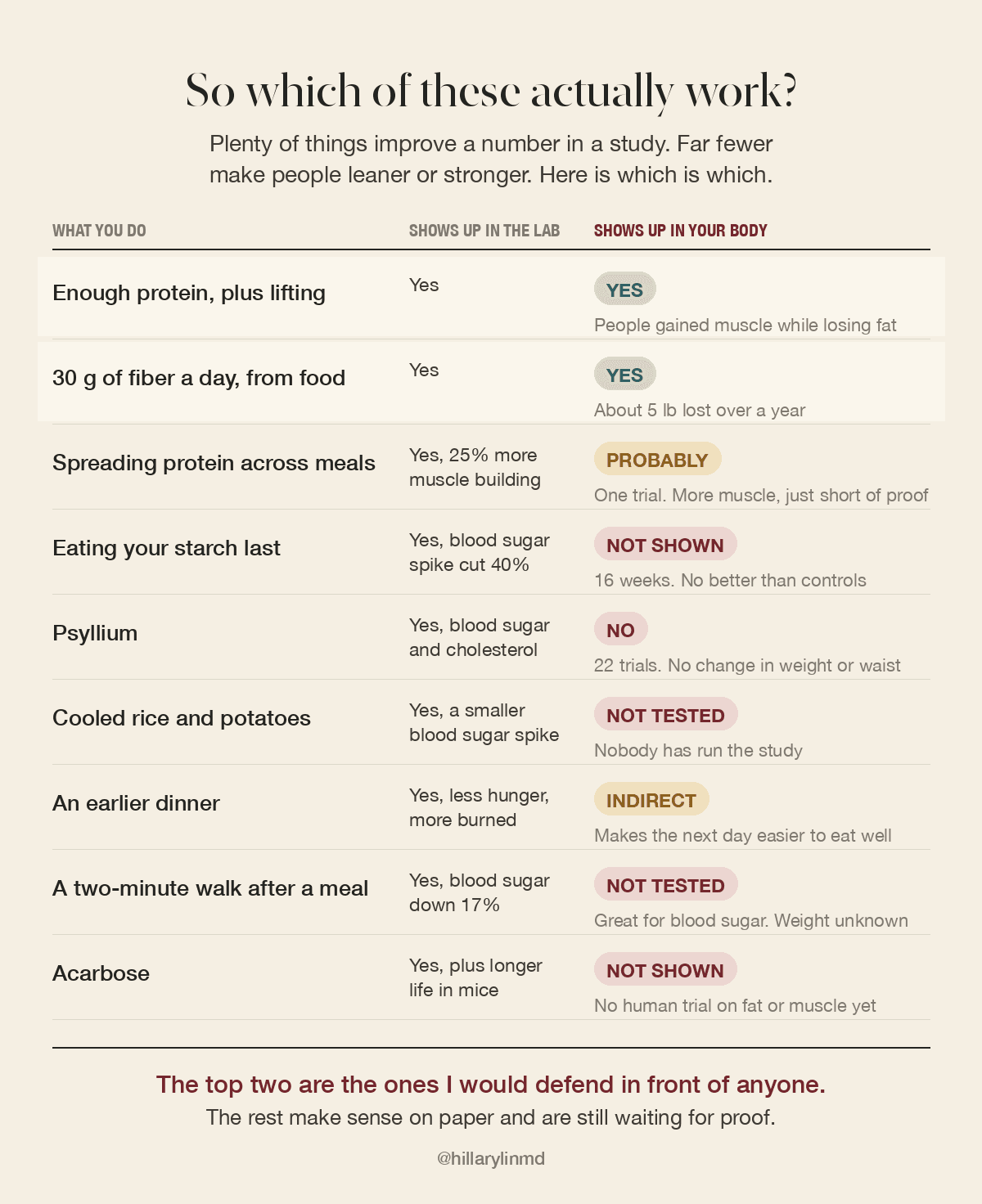
Every popular lever, graded twice: what it reliably changes, and whether anyone has shown it changes fat or muscle.
"Not shown" is not the same as "does not work." Several have good mechanisms and no adequately powered trial. It does mean you should not spend your willpower there first.
2 of 9
The two that carry the weight
Protein plus lifting decides which tissue leaves in a deficit. Young men at a 40 percent deficit, training six days a week, gained 1.2 kg of lean mass and lost 4.8 kg of fat on high protein. The moderate-protein group held lean flat.
Fiber is the one nobody expects. Researchers gave 240 adults either the AHA's thirteen-component diet or one instruction: eat 30 grams of fiber a day. After a year, the fiber group had lost 2.1 kg against the AHA group's 2.7 kg — not a significant gap.
The trial was built to find a difference. What it shows is that one simple instruction produced real weight loss in people who had already failed complicated diets.
Muscle treats each meal like a switch
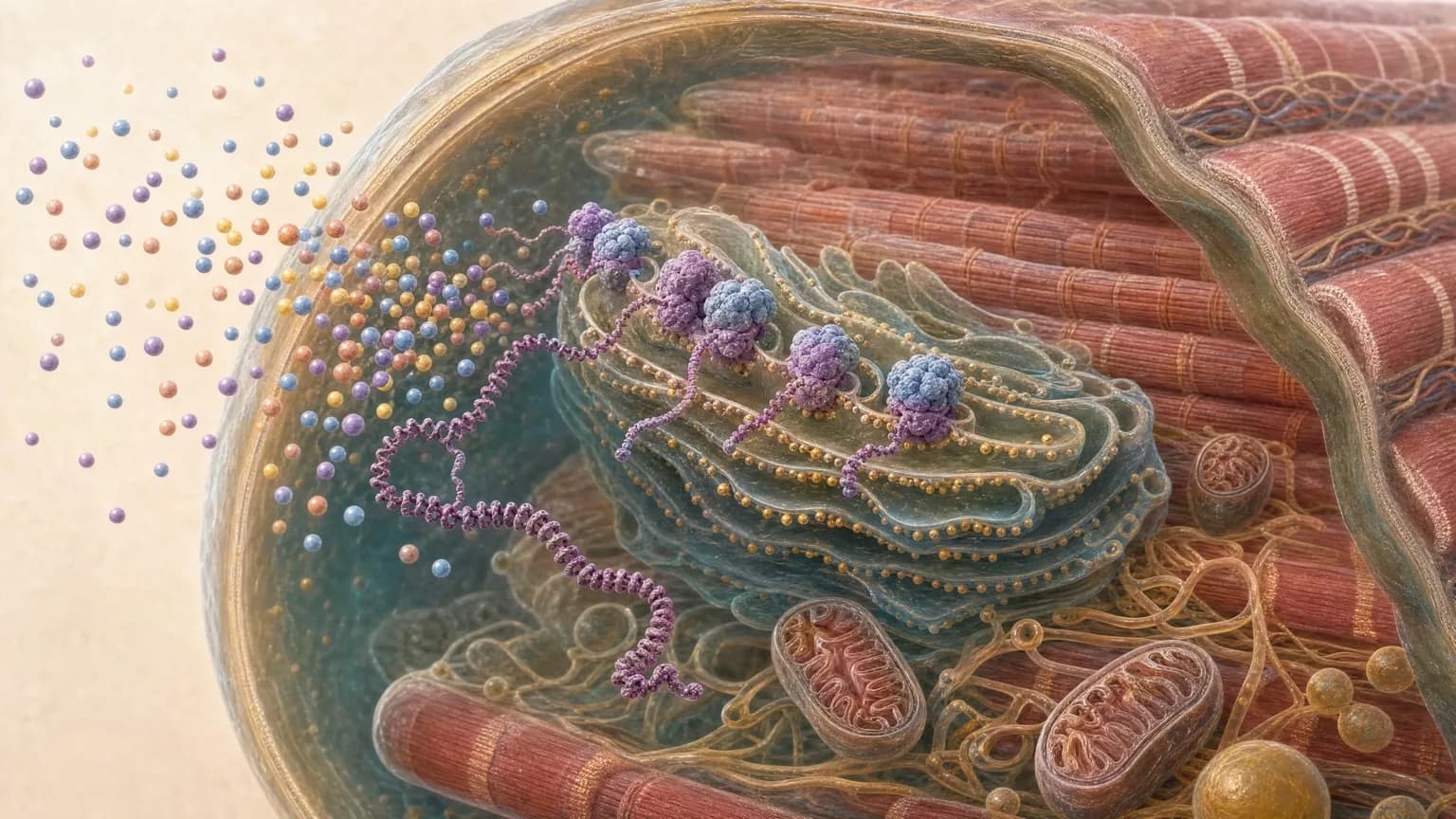
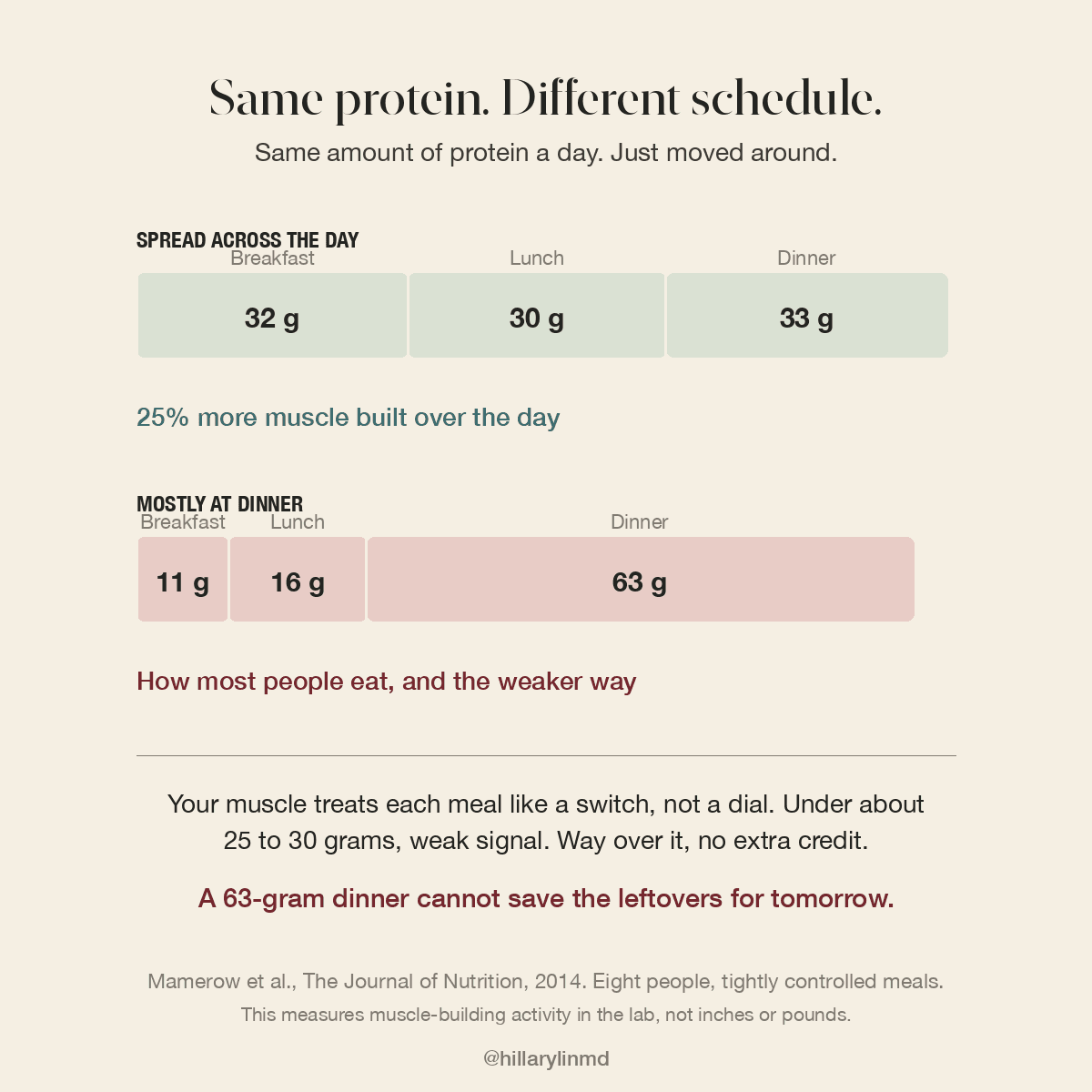
Simplified teaching model. The 24-hour synthesis finding is a lab measurement in a small controlled study; the twelve-week trial on breakfast-loaded protein landed just outside statistical significance.
Sometimes you want the spike
Almost everything here flattens the curve. Not always what you want.
- Fast is right past 90 minutes of hard endurance work. Simple, liquid, now.
- Fast is right when your blood sugar has dropped and you feel shaky.
- Fast has a case around heavy lifting. Insulin is a growth signal, not a villain.
- Slow is right in a fat-loss phase, which is nearly every meal.
- Slow is right on a desk day, and at dinner when the couch is next.
- Slow is right with prediabetes or insulin resistance, where big spikes do real damage.
The order to fix things in
Each step only matters once the one above it is handled.
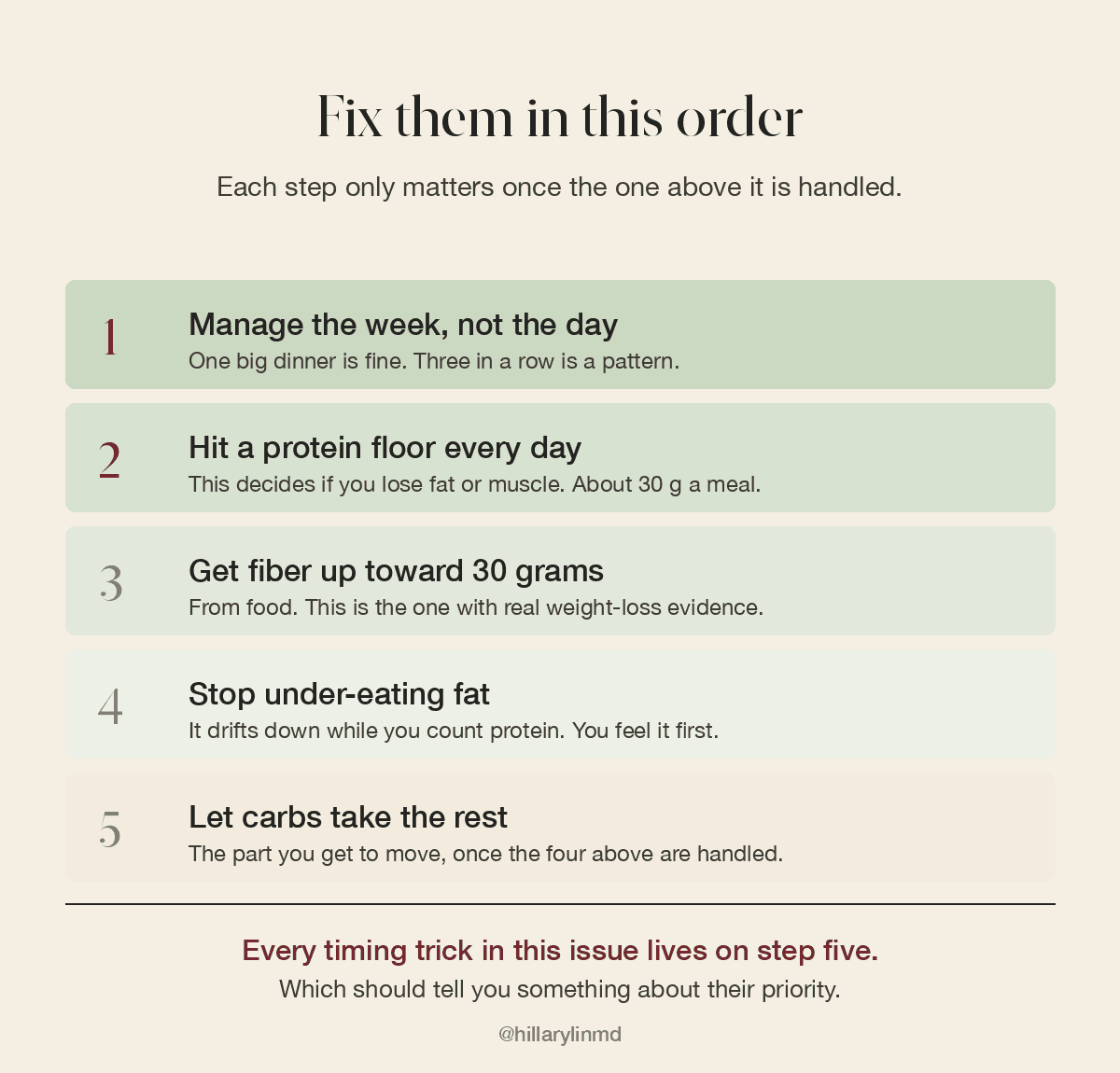
How I’d decide
- Who it's for
- Anyone who has read a lot of conflicting nutrition advice and wants to know which parts are load-bearing.
- Who should skip it
- This is a prioritization page, not a prescription. Pregnancy, disordered eating history, insulin or sulfonylurea use, and kidney disease all change the ordering. Get yours from your own clinician.
- What to measure
- Weekly average weight, waist, strength, energy, hunger, sleep. A flatter glucose curve after lunch is worth having, but it is not evidence your body composition is changing.
- What I do
- I do most of the small stuff, because it is free and steadier blood sugar is worth having. I just do not confuse it with the work. The work is protein, lifting, and fiber.
- What would change my mind
- A properly powered trial that ran one of the mechanism-only levers long enough to measure body composition would move a row on the scorecard.
In short
Two levers are proven. Total protein with lifting, and 30 grams of fiber a day.
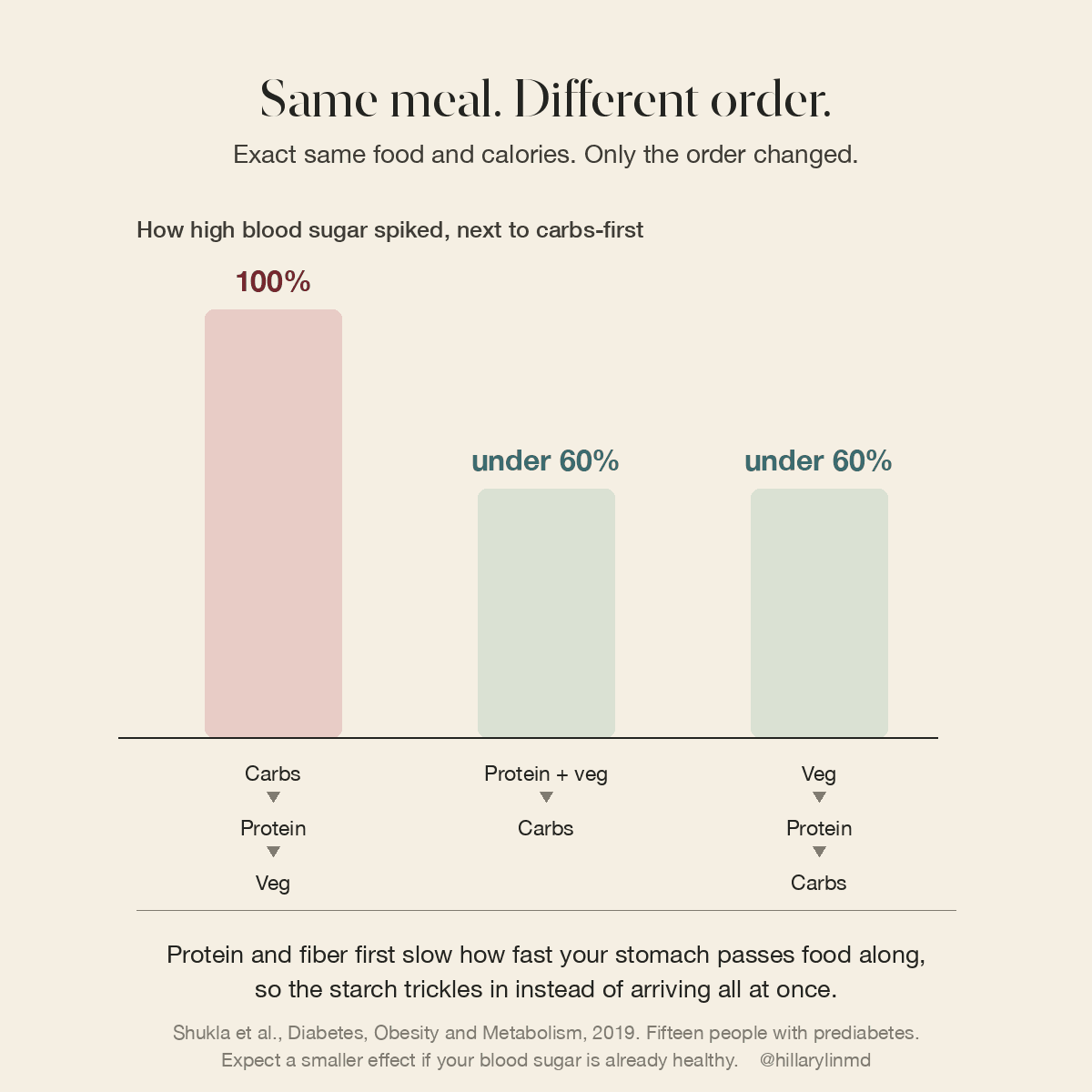
Most of the rest move a marker. Starch last, cooled rice, psyllium, and post-meal walks all flatten glucose. None has been shown to make anyone leaner.
Two are simply oversold. The pre-workout carb and fasted cardio. Both have been tested. Both failed.
Flat glucose is still worth having. Just not instead of the protein, the lifting, and the fiber.
Common questions
- Does meal timing matter for weight loss?
- Much less than the internet suggests. The levers with proven effects on body composition are total daily protein paired with resistance training, and about 30 grams of fiber a day — neither of which is about timing. Changes that reliably flatten blood sugar, like eating starch last or walking after meals, have not been shown to make people leaner.
- Is nutrient timing a myth?
- Oversold rather than fake. Two timing effects survive scrutiny: spreading protein across meals produced about 25 percent more muscle building over 24 hours, and eating late measurably raises hunger and lowers energy expenditure. The rest of the canon — the pre-workout carb, fasted cardio, the anabolic window — fails when tested.
- What is the best meal timing for building muscle?
- Hit your daily protein total first. Then split it across three or four meals so each lands near 30 grams, and put one at breakfast. Muscle treats each meal like a switch rather than a dial: under roughly 25 to 30 grams the signal is weak, and far above it there is no bonus. A 63-gram dinner cannot bank the extra for tomorrow.
- Should I eat carbs at night?
- The carbohydrate is not the problem; the lateness is. In a controlled crossover matching food, activity, sleep, and light, eating later made people hungrier, lowered energy burned while awake, and changed how fat tissue handled fat. Your body also handles sugar better in the morning. Late eating mostly makes tomorrow harder.
- If most of these do not change body composition, why do them?
- Because steadier blood sugar is worth having on its own terms, and several cost nothing. The mistake is doing them instead of the protein, the lifting, and the fiber. Most people polish the last five percent before the first 90 percent is done.
Keep reading
Sources
- 1Longland et al. Higher compared with lower dietary protein during an energy deficit combined with intense exercise. Am J Clin Nutr, 2016.
- 2Ma et al. Single-component versus multicomponent dietary goals for the metabolic syndrome. Ann Intern Med, 2015.
- 3Mamerow et al. Dietary protein distribution positively influences 24-h muscle protein synthesis. J Nutr, 2014.
- 4Yasuda et al. Evenly distributed protein intake over 3 meals augments resistance exercise-induced muscle hypertrophy. J Nutr, 2020.
- 5Shukla et al. Effect of food order on glycemic excursions in prediabetes. Diabetes Obes Metab, 2019.
- 6Shukla et al. A food-order behavioral intervention in prediabetes: a 16-week randomized trial. 2023.
- 7Buffey et al. The acute effects of interrupting prolonged sitting with light-intensity walking. Sports Med, 2022.
- 8Jane et al. Effect of psyllium fibre supplementation on body weight and composition: meta-analysis of 22 randomized controlled trials. 2019.
- 9Harrison et al. Acarbose, 17-α-estradiol, and nordihydroguaiaretic acid extend mouse lifespan preferentially in males. Aging Cell, 2014.
- 10Vujović et al. Late isocaloric eating increases hunger, decreases energy expenditure. Cell Metab, 2022.
- 11Fuchs et al. Carbohydrate intake of 10 g/kg body mass rapidly replenishes liver, but not muscle glycogen. J Physiol, 2025.
- 12Schoenfeld et al. Body composition changes associated with fasted versus non-fasted aerobic exercise. J Int Soc Sports Nutr, 2014.
No supplement store. No affiliate ranking. Nothing on this page is sold.