Body Recomposition Calculator: Your Floor, Your Ordinary Day, Your Flex Day
Body recomposition means losing fat while holding or building muscle. Two things decide whether that works: eating enough protein and lifting something heavy. Everything else is adjustment on top. This calculator gives you a floor, an ordinary day, and a flex day for calories, protein, fiber, and fat, because a single target is what makes people quit in week three.
Three numbers, not one
A floor, an ordinary day, and a planned flex day. A flex day you chose is not the same as a day that got away from you.
Protein is the load-bearing input
In a deficit, protein plus resistance training is what decides whether the weight you lose is fat or muscle.
Fiber has real outcome evidence
In a year-long trial, a single instruction to eat 30 grams of fiber a day produced weight loss close to a thirteen-part diet.
The week beats the day
Your body responds to the weekly average. One big dinner is fine. Three unplanned ones in a row is a pattern.
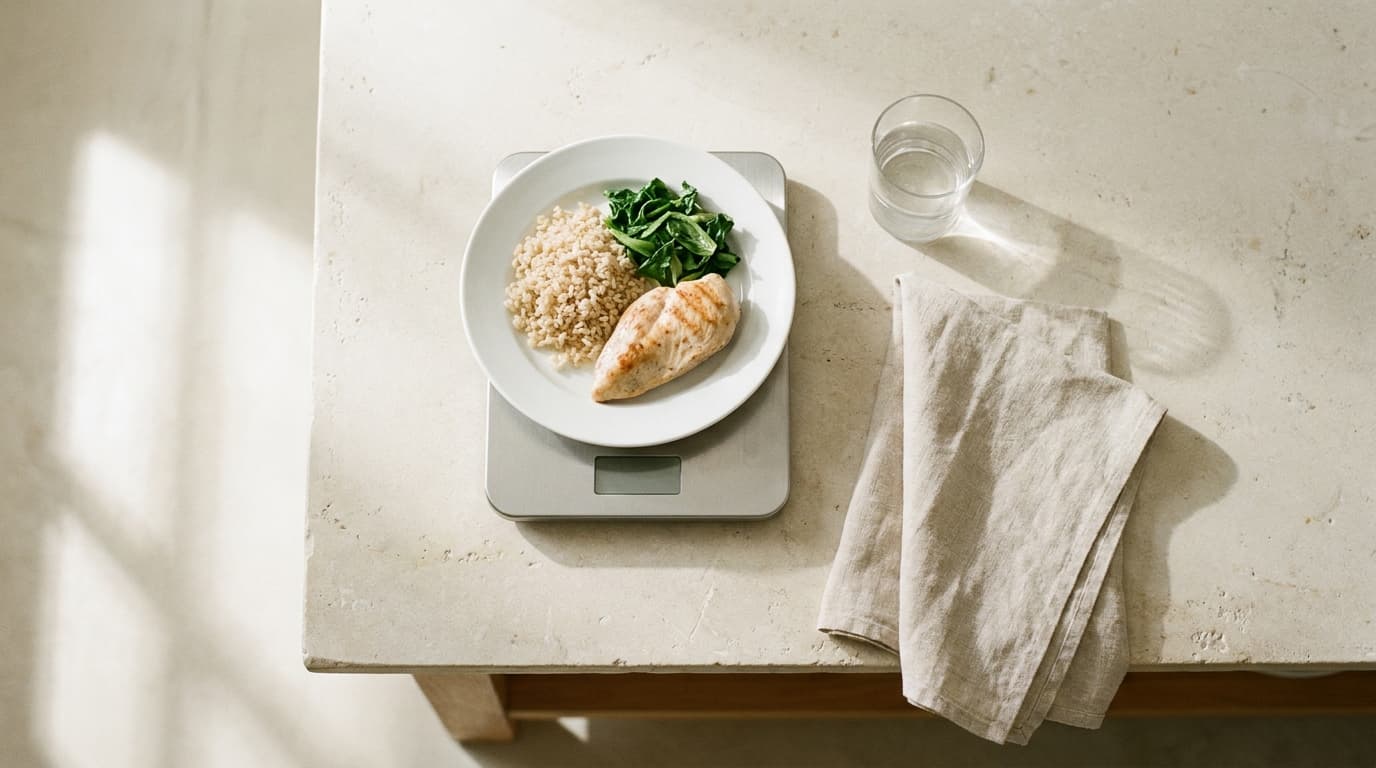
Your three numbers
A floor you do not go under, an ordinary day, and a flex day. Estimates to start from and adjust against the scale, the mirror, and how you feel, not targets to defend.
| Per day | Floor | Ordinary day | Flex day |
|---|---|---|---|
| Calories | 1225 | 1800 | up to 2425 |
| Protein | 80 g | 110 g | no need past 150 g |
| Fiber | 20 g | 25 g | ease past 35 g |
| Fat | 40 g | 55 g | flexible |
| Carbs | no fixed floor | about 215 g | absorbs the rest |
That protein works out to roughly 25 g per meal across four meals. Breakfast is the one people miss.
Resting burn about 1367, daily burn about 2119. Both are estimates with real spread between people.
Educational, not personal medical advice. Estimates use the Mifflin-St Jeor equation with a standard activity multiplier, and both carry meaningful individual variation. If you are pregnant or breastfeeding, have kidney disease, take insulin, or have a history of disordered eating, use these numbers only alongside your own clinician. On a GLP-1, these targets still apply, and the protein floor matters more than usual, not less.
Why three numbers instead of one
Almost every macro calculator gives you a single daily target. That works right up until a birthday, a work trip, or a dinner someone else planned. Then the number is missed, the day is labelled a failure, and failure is what makes people quit.
A floor protects you: it is the line you do not go under, even on a bad day. An ordinary day is what a normal Tuesday looks like. A flex day is room you planned in advance for the dinner out.
Your body responds to the week, not the day. Two big days inside five ordinary ones is a completely different thing from two big days that ambushed you, even when the calories match exactly.
The order to fix things in
When something has to give, this is the order I use. Each step only matters once the one above it is handled.
Manage the week, not the day. One big dinner is fine. Three in a row is a pattern.
Hit a protein floor every single day. This is what decides whether the weight you lose is fat or muscle, and it is the one people skip.
Get fiber up, and aim for 30 grams. From food, not a supplement scoop.
Do not keep under-eating fat. It drifts down while you are busy counting protein and calories.
Let carbs take whatever is left. This is the part you get to move around, once the four above are handled.
Where these numbers come from
Calories start from the Mifflin-St Jeor equation for resting metabolic rate, multiplied by a standard activity factor. Both steps carry real variation between people, so treat the output as a starting range and adjust it against what actually happens over three to four weeks.
Protein is scaled to body mass rather than calories, because that is how the evidence is built: a floor near 1.2 grams per kilogram, an ordinary target near 1.6, and roughly 2.2 as the point past which more protein stops adding much. In a marked deficit with hard training, the higher end is where the muscle-sparing data sits.
Fiber follows the dietary reference of about 14 grams per 1,000 calories, held between 25 and 35 grams. Fat has a floor near 0.6 grams per kilogram so it does not quietly drift down while you chase protein. Carbohydrate takes the remainder.
What the calculator will not do
It will not show a calorie floor below 1,200 for women or 1,500 for men, regardless of what the arithmetic produces. Eating under those numbers on purpose, without supervision, is where people lose muscle, bone density, and menstrual cycles.
It also cannot see your training history, your medications, your thyroid, your sleep, or your last set of labs. It is a starting point for a conversation, not a substitute for one.
How I’d decide
Who it’s for
Anyone trying to lose fat without losing muscle, or hold their weight while improving how their body is composed. It is most useful if you already train or intend to, and want a starting range rather than a rigid plan.
Who should skip it
Do not use this as a target if you are pregnant or breastfeeding, if you have a history of disordered eating, or if you have kidney disease or take insulin. Those situations need individualized targets from your own clinician, not an equation. If you are on a GLP-1, this calculator is for you rather than against you: the protein floor becomes more important, not less.
Measure before / after
Track the weekly average rather than any single day. Alongside weight, watch waist measurement, strength in the gym, energy, sleep, hunger, bowel regularity, and standardized photos. If weight is flat but strength and waist are moving in the right direction, the plan is working.
What I’d do first
I hold a protein floor I hit every day, keep fiber in the 25 to 30 gram range, and refuse to let fat drift too low. Carbohydrate takes whatever is left, which on a training day is more than people expect from a longevity doctor. I plan flex days rather than apologize for them.
What would change my mind
Better evidence on protein distribution would move me. Right now the strongest data is that total daily protein is what matters, with one encouraging twelve-week trial suggesting that moving some of it to breakfast adds a little more. If larger trials show distribution does nothing once total intake is controlled, I would drop that emphasis and keep the total.
Frequently Asked Questions
Can you really build muscle while losing fat?
Yes, and there is a proof-of-principle trial for it. Young men eating at roughly a 40% calorie deficit for four weeks, while training six days a week, gained 1.2 kg of lean mass and lost 4.8 kg of fat on higher protein. A comparison group on moderate protein held lean mass flat. That was a supervised study in trained young men, so treat it as direction rather than a promise, but the direction is well supported.
How much protein do I actually need?
For body recomposition, somewhere around 1.6 grams per kilogram of body weight is a sensible ordinary target, with a floor near 1.2 and little added benefit past about 2.2. In practice, aiming for roughly 30 grams per meal across three or four meals gets most people there without arithmetic.
Does it matter when I eat the protein?
A little, probably. The same daily protein spread evenly across meals produced about 25% more muscle building over 24 hours than the same amount skewed toward dinner. A separate twelve-week trial found the breakfast-loaded group gained more lean tissue, though the difference landed just outside statistical significance. Total daily protein is the main event; moving some of it to breakfast is a reasonable free bet on top.
Should I eat before a workout?
For sessions under about 90 minutes, you are running on fuel stored over the previous day, not on what you ate an hour ago. Imaging studies show a large carbohydrate breakfast does not measurably raise muscle glycogen. Eat beforehand if you prefer to, for comfort and blood sugar. It is not loading your muscles.
Is fasted cardio better for fat loss?
No. Training fasted does burn a higher proportion of fat during the session, but when researchers randomized people to fasted or fed cardio while eating in a deficit, both groups lost the same fat. Your body settles the balance over days, not over one workout.
I am on a GLP-1. Do these numbers still apply?
Yes, and the protein floor matters more for you than for almost anyone else. GLP-1 medications work partly by suppressing appetite, which is the point, but it means weight comes off fast and protein is the easiest thing to under-eat when nothing sounds good. A meaningful share of the weight lost on these drugs is lean mass, and that is the outcome the protein floor and resistance training exist to prevent. Practically: eat protein first at every meal while your appetite is small, and treat the floor as non-negotiable even on days you are not hungry. Do talk to whoever prescribes it before making large changes to what you eat.
How many calories should I eat to lose fat but keep muscle?
Start from your estimated daily burn and take about 15% off, then hold a protein floor and lift. The calculator on this page works that out for you and gives three numbers rather than one: a floor you do not go under, an ordinary day, and a planned flex day. For most people the ordinary day lands somewhere between 1,600 and 2,400 calories, but that range is wide because body size, sex, and training load move it a lot.
What is body recomposition?
Body recomposition means changing what your body is made of rather than only what it weighs: losing fat while holding or adding muscle. It is why the scale becomes a poor instrument once you start caring which tissue is leaving. Someone can finish a recomposition phase at the same weight and look and function completely differently.
How much fiber should I eat a day?
Aim for about 30 grams a day from food. In a year-long randomized trial, adults with metabolic syndrome told only to eat 30 grams of fiber daily lost weight nearly as well as a group following a thirteen-component diet. Build up gradually with plenty of fluid, because jumping straight to a high intake is what causes the bloating that makes people quit.
What if I miss my numbers on a given day?
Then you had a day. That is what the floor and the flex day exist for. Look at the weekly average instead, and return to your ordinary baseline the next day rather than compensating with fasting or extra cardio.
References & citations
- 1.Longland et al. Higher compared with lower dietary protein during an energy deficit combined with intense exercise. Am J Clin Nutr, 2016.
- 2.Mamerow et al. Dietary protein distribution positively influences 24-h muscle protein synthesis. J Nutr, 2014.
- 3.Yasuda et al. Evenly distributed protein intake over 3 meals augments resistance exercise-induced muscle hypertrophy. J Nutr, 2020.
- 4.Ma et al. Single-component versus multicomponent dietary goals for the metabolic syndrome. Ann Intern Med, 2015.
- 5.Schoenfeld et al. Body composition changes associated with fasted versus non-fasted aerobic exercise. J Int Soc Sports Nutr, 2014.
- 6.Fuchs et al. Carbohydrate intake of 10 g/kg body mass rapidly replenishes liver, but not muscle glycogen. J Physiol, 2025.
- 7.Mifflin et al. A new predictive equation for resting energy expenditure. Am J Clin Nutr, 1990.
Related Guides
Turn the guide into the right next decision.
If this page raised a real clinical question, start with the practice details. If you are still learning, get the weekly letter. If you are comparing tests, use the testing hub before buying another panel.