Nutrition
Fiber, Constipation, and Bloating: What Helps, What Backfires, and How Much You Need
Fiber is not one substance, and more is not always better. Match the type and dose to the job your gut actually needs.

Fiber-rich foods belong in a healthy diet, but constipation does not always come from too little fiber. A gel-forming fiber such as psyllium may help hard, dry, or infrequent stool. More bulk may do little or worsen pressure when stool is already soft but still feels blocked or incomplete. The goal is not to maximize a nutrition score. It is to match the fiber to the job and find a dose your gut can use.
Start with the problem you are trying to solve
The nutrition label gives total grams. It does not tell you whether the fiber forms a gel, holds water, ferments quickly, or adds coarse stool bulk. Those traits often matter more than the score.
Start with the outcome you want. Lowering LDL cholesterol, softening hard stool, reducing bloating, and supporting a long-term food pattern are different jobs.
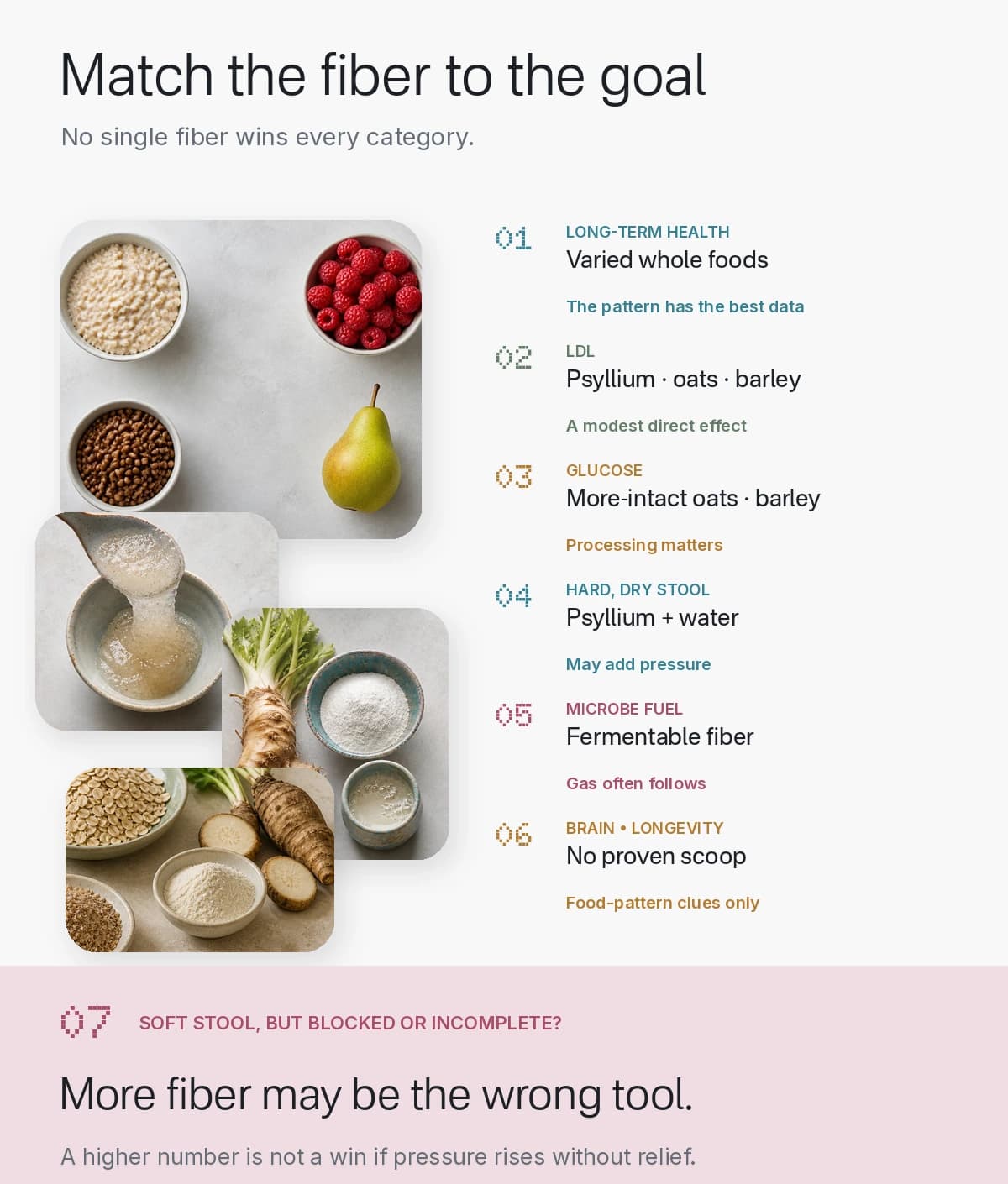
Match the fiber to the goal
Lower LDL or ApoB
- What may help
- Psyllium or enough intact oat or barley beta-glucan to retain viscosity
- What may miss the problem
- A token amount of processed oat fiber; replacing indicated medication
Hard, dry, or infrequent stool
- What may help
- A slow trial of psyllium with enough fluid; kiwifruit or prunes for some people
- What may miss the problem
- A large dose added quickly; psyllium without enough fluid
Gas after high-fiber products
- What may help
- Check for inulin, chicory root, FOS, GOS, sugar alcohols, and large seed loads
- What may miss the problem
- Adding another fermentable powder because the label says prebiotic
Daily stool that still feels incomplete
- What may help
- Review stool form, straining, blockage, medications, pelvic-floor coordination, sensation, and transit
- What may miss the problem
- Treating frequency alone; repeatedly adding bran or other bulk
Long-term health
- What may help
- A steady, tolerated pattern of whole grains, legumes, fruit, vegetables, nuts, and seeds
- What may miss the problem
- Assuming an isolated supplement reproduces the whole-food mortality association
Brain protection
- What may help
- Control vascular risks, exercise, sleep, hearing, and other proved targets
- What may miss the problem
- Using prebiotic fiber as a nootropic
| Goal or symptom | What may help | What may miss the problem |
|---|---|---|
| Lower LDL or ApoB | Psyllium or enough intact oat or barley beta-glucan to retain viscosity | A token amount of processed oat fiber; replacing indicated medication |
| Hard, dry, or infrequent stool | A slow trial of psyllium with enough fluid; kiwifruit or prunes for some people | A large dose added quickly; psyllium without enough fluid |
| Gas after high-fiber products | Check for inulin, chicory root, FOS, GOS, sugar alcohols, and large seed loads | Adding another fermentable powder because the label says prebiotic |
| Daily stool that still feels incomplete | Review stool form, straining, blockage, medications, pelvic-floor coordination, sensation, and transit | Treating frequency alone; repeatedly adding bran or other bulk |
| Long-term health | A steady, tolerated pattern of whole grains, legumes, fruit, vegetables, nuts, and seeds | Assuming an isolated supplement reproduces the whole-food mortality association |
| Brain protection | Control vascular risks, exercise, sleep, hearing, and other proved targets | Using prebiotic fiber as a nootropic |
How much fiber do adults need?
The U.S. Dietary Reference Intake uses 14 grams of fiber per 1,000 calories. This is an Adequate Intake, not a Recommended Dietary Allowance based on a known deficiency disease. At 1,700 to 1,900 calories per day, the formula gives roughly 24 to 27 grams.
The World Health Organization recommends at least 25 grams per day from naturally occurring fiber in whole grains, vegetables, fruits, and pulses. It does not say to add isolated inulin, bran, or psyllium until an app turns green.
Long-term studies do show a real association. In NIH-AARP, the highest-fiber group had a relative risk of 0.78 for death compared with the lowest group. In EPIC, each 10-gram-per-day difference was linked to about 10% lower all-cause mortality. A 2024 analysis of 64 cohorts and more than 3.5 million people found a hazard ratio of 0.77 for all-cause mortality in the highest versus lowest groups. PMID 21321288, PMID 22648726, PMID 38011755
Those studies support a fiber-rich food pattern. They cannot fully separate fiber from whole grains, micronutrients, plant compounds, food replacement, smoking, exercise, health care, or other differences between people who eat very different diets. They also cannot prove that forcing one symptomatic person from 22 to 28 grams will improve health.
- If intake is very low, replace refined foods with tolerated whole grains, legumes, fruit, vegetables, nuts, and seeds.
- If you already eat roughly 20 to 25 grams per day from intact foods, you are not obviously failing.
- If more fiber causes persistent gas, pressure, pain, or less satisfactory bowel movements, hold the dose steady or step back while you identify the cause.
- Keep intake steady enough to learn from the result. Large day-to-day swings are hard to interpret.
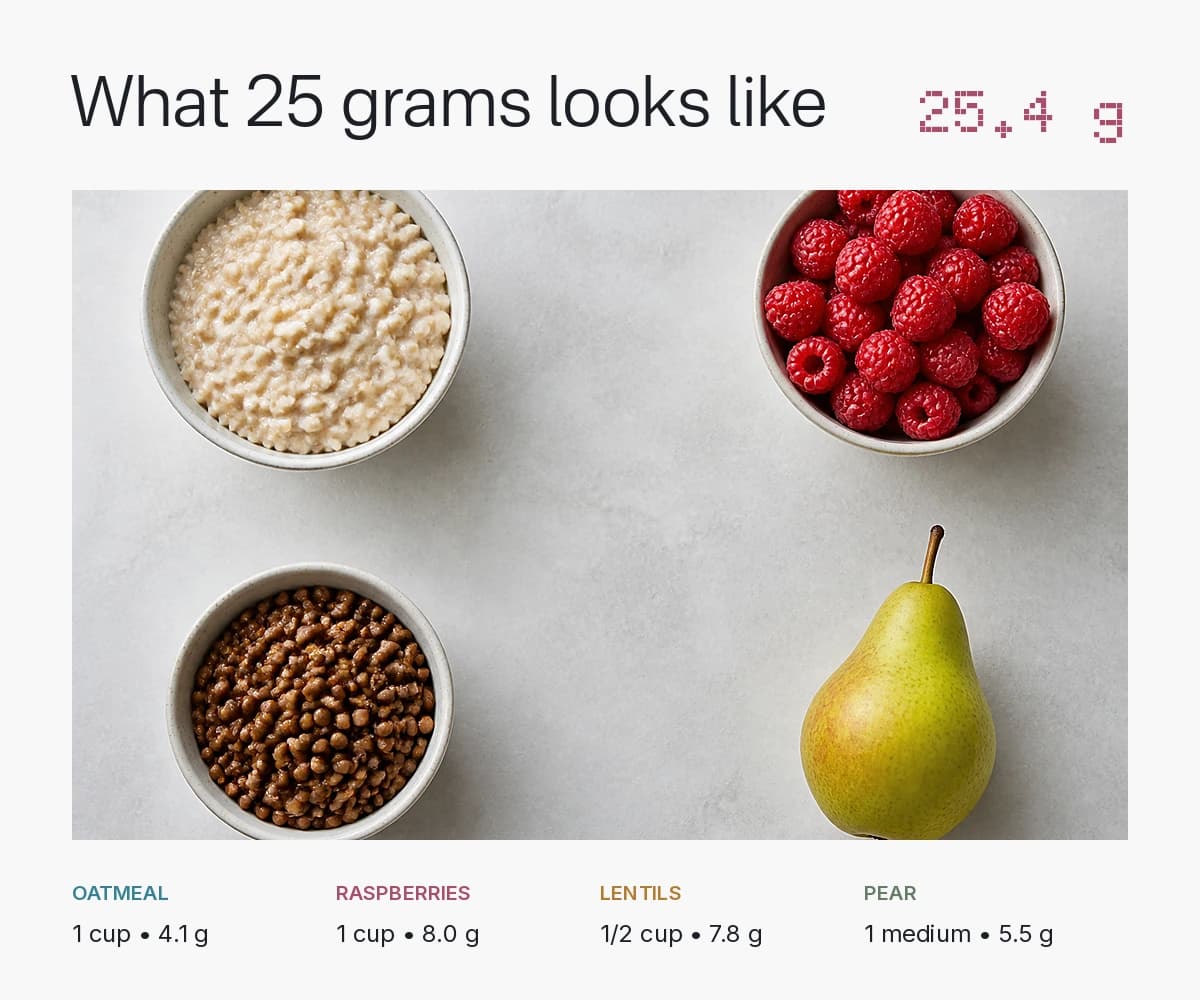
25–30 g
What each study can tell us
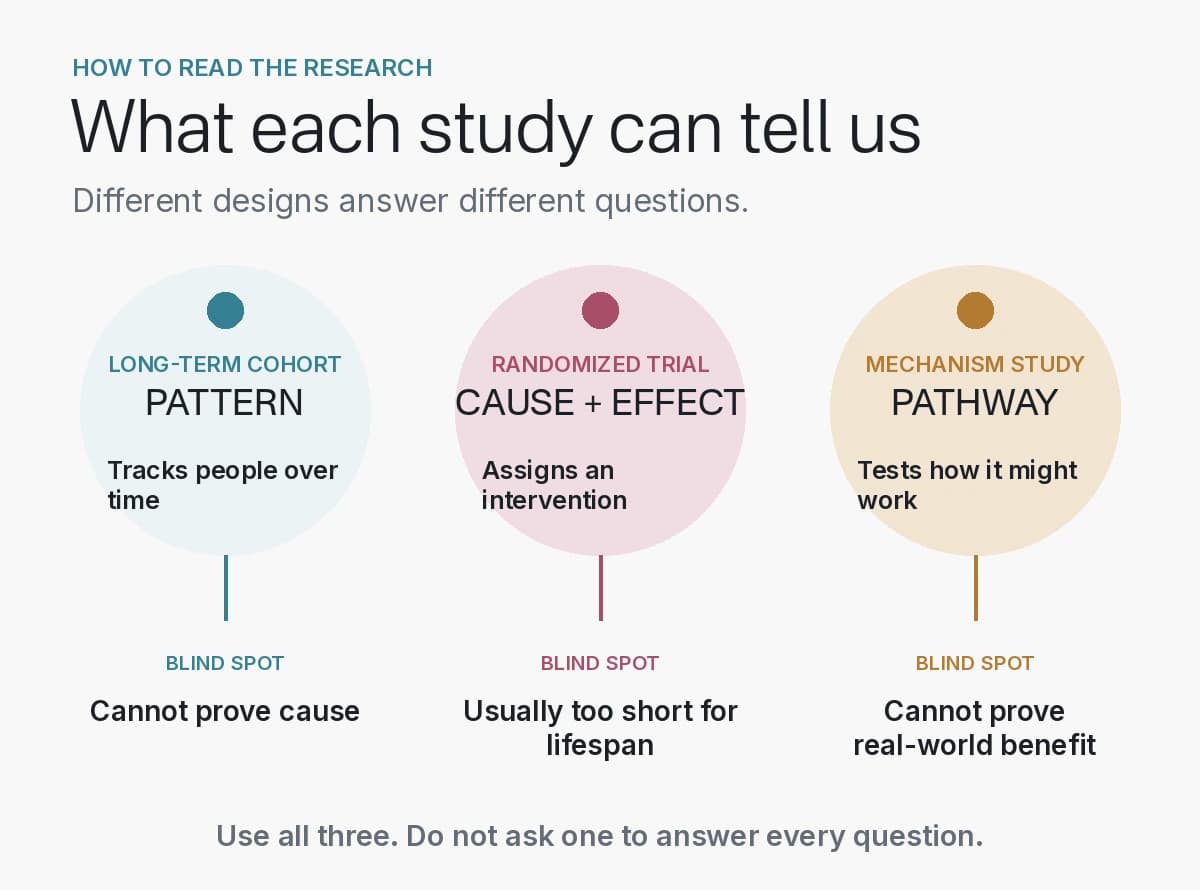
Long-term cohort studies can show patterns across years, but they cannot prove that fiber caused the difference. Randomized trials can test cause and effect, but most are too short to measure lifespan or major disease outcomes. Mechanism studies can show a pathway without proving a real-world benefit.
Use all three. Do not ask one study design to answer every question.
Fiber is not one substance
Viscous, gel-forming fibers include psyllium and sufficiently intact oat or barley beta-glucan. They can interfere with bile-acid reabsorption, slow nutrient movement, and hold water. In a 26-week trial, 5.1 grams of psyllium twice daily lowered LDL cholesterol by 6.7% relative to cellulose placebo in adults with high cholesterol. PMID 10837282
Viscosity matters. In a randomized breakfast study, 4 grams of intact, viscous oat beta-glucan delayed gastric emptying and reduced post-meal glucose and insulin. Enzymatic breakdown lowered viscosity and removed those effects. Processing, molecular weight, and dose matter, not just the word oats. PMID 31828287
Rapidly fermented fibers include inulin, chicory-root fiber, FOS, and GOS. Gut microbes turn these carbohydrates into short-chain fatty acids and gases. Those metabolites have real biological roles, but raising them does not prove better long-term health for one person. Gas is a predictable product of fermentation, not a failure of willpower.
Coarse insoluble fibers such as wheat bran add fecal mass. They can help some people, but extra bulk is not always useful. In a 275-person primary-care trial in irritable bowel syndrome, psyllium improved adequate symptom relief during the first two months. Bran did not provide the same sustained benefit and caused more early dropout because symptoms worsened. PMID 19713235
Intact foods provide more than fiber. Oats, barley, beans, lentils, fruit, vegetables, nuts, seeds, and whole grains also carry minerals, vitamins, unsaturated fats, and plant compounds. They change what other foods get eaten and best match the exposures in the long-term studies.
What has been proved, and what remains proposed?
A mechanism can be real without proving that a product prevents disease. Keep the claim tied to the study that tested it.
Evidence map
Viscous psyllium and adequate-dose oat beta-glucan lower LDL
- Best reading of the human evidence
- Demonstrated in randomized trials; the average effect is modest
Intact viscous beta-glucan reduces post-meal glucose and insulin
- Best reading of the human evidence
- Demonstrated acutely; this does not prove fewer diabetes cases or deaths
Psyllium holds water and can soften stool
- Best reading of the human evidence
- Demonstrated; benefit depends on the constipation pattern and dose
Fermentable fiber changes microbes and short-chain fatty acids
- Best reading of the human evidence
- Demonstrated; the health value of a given change is not settled
Fiber improves microbiome diversity
- Best reading of the human evidence
- Not consistent across human feeding trials
Fiber lowers systemic inflammation
- Best reading of the human evidence
- Not consistent across human feeding trials
Fiber prevents colorectal cancer through faster transit or butyrate
- Best reading of the human evidence
- Plausible, but fiber trials have not confirmed cancer prevention
Fiber reliably makes people eat less and lose weight
- Best reading of the human evidence
- Not shown; fullness can improve, but calorie and weight effects are usually small
An isolated supplement reproduces the mortality signal of whole foods
- Best reading of the human evidence
- Not shown
Prebiotic fiber prevents cognitive decline or dementia
- Best reading of the human evidence
- Not shown
| Claim | Best reading of the human evidence |
|---|---|
| Viscous psyllium and adequate-dose oat beta-glucan lower LDL | Demonstrated in randomized trials; the average effect is modest |
| Intact viscous beta-glucan reduces post-meal glucose and insulin | Demonstrated acutely; this does not prove fewer diabetes cases or deaths |
| Psyllium holds water and can soften stool | Demonstrated; benefit depends on the constipation pattern and dose |
| Fermentable fiber changes microbes and short-chain fatty acids | Demonstrated; the health value of a given change is not settled |
| Fiber improves microbiome diversity | Not consistent across human feeding trials |
| Fiber lowers systemic inflammation | Not consistent across human feeding trials |
| Fiber prevents colorectal cancer through faster transit or butyrate | Plausible, but fiber trials have not confirmed cancer prevention |
| Fiber reliably makes people eat less and lose weight | Not shown; fullness can improve, but calorie and weight effects are usually small |
| An isolated supplement reproduces the mortality signal of whole foods | Not shown |
| Prebiotic fiber prevents cognitive decline or dementia | Not shown |
Constipation is not only about frequency
You can have a bowel movement every day and still have a symptom pattern consistent with constipation. Hard or lumpy stool, repeated straining, blockage, incomplete evacuation, and manual assistance all matter.
Fiber is a reasonable first trial when stool is hard, dry, or infrequent, especially when intake is low. An updated review of 16 randomized trials found a treatment response in 66% of participants receiving a fiber supplement and 41% receiving control. Psyllium and pectin had the clearest signals. Flatulence increased, and results varied greatly between trials. PMID 35816465
If stool is already soft but you repeatedly strain, feel blocked, or do not feel emptied, the main problem may involve pelvic-floor coordination, rectal sensation, slow propulsion, or a medication effect. Adding bulk does not correct a pelvic floor that tightens when it should relax. It may increase pressure and abdominal volume.
The joint AGA and ACG guideline gives fiber a conditional recommendation based on low-certainty evidence for chronic idiopathic constipation. Among the supplements reviewed, only psyllium appeared effective. The same guideline gives polyethylene glycol, or PEG, a strong recommendation based on moderate-certainty evidence. AGA/ACG guideline
- Hard, dry, or infrequent stool: a slow psyllium trial may fit.
- Soft stool with blockage or incomplete evacuation: seek an evaluation instead of adding bulk.
- Persistent incomplete evacuation may call for a rectal examination, anorectal testing, transit assessment, or pelvic-floor evaluation.
- Constipation that persists after a reasonable trial is not proof that you need a larger fiber trial.
Bloating and abdominal distension are not fat gain
Bloating is the feeling of fullness or pressure. Distension is a visible increase in abdominal size. Fermentation creates gas, gel-forming fiber holds water, and insoluble fiber adds stool mass. All three can increase the amount of material inside the gut without changing body fat.
A 2026 double-blind crossover trial gave 41 people with functional bloating 8 grams per day of fructan or alpha-GOS for seven days. About 18% reacted to fructan and 20% to alpha-GOS with induced symptoms. Higher baseline symptoms and abdominal distension predicted response. PMID 41841608
- Measure at the same time of day and under the same conditions.
- Note meals, bowel movements, menstrual timing when relevant, and added fiber ingredients.
- Compare one food or supplement at a time.
- Do not treat a morning-to-evening change as fat gain.
Oatmeal in this framework
Oats are a useful whole grain. They are not a universal constipation treatment. Heating overnight oats is fine and does not erase the fiber. Portion size, processing, beta-glucan viscosity, and added ingredients matter more than whether the oats are warm or cold.
Plain oats may be well tolerated while a high-fiber packet creates much more fermentation or volume. Check the ingredient list for inulin, chicory-root fiber, FOS, GOS, sugar alcohols, and a large amount of chia, flax, or other seeds.
Enough intact, viscous beta-glucan can modestly lower LDL and reduce post-meal glucose. A standard serving does not automatically contain the 3 to 4 grams of intact beta-glucan used in many metabolic studies. The total-fiber line does not tell you its beta-glucan dose or molecular weight.
Oatmeal may also help when it replaces a more calorie-dense breakfast and keeps someone satisfied. Adding it or a fiber powder on top of the same diet may not have the same effect.

A two-week experiment that can teach you something
This is an educational framework, not a personal treatment plan. For three ordinary days, record estimated intake and usual food sources without trying to create a perfect day. Then keep the baseline reasonably steady for one to two weeks.
- Change one source: compare plain oats with an inulin-containing packet, remove one added prebiotic powder, or test one gel-forming fiber instead of several products.
- Track Bristol stool form, spontaneous and complete bowel movements, straining, blockage, incomplete evacuation, gas, pain, and visible distension.
- Better stool form and more complete emptying with tolerable gas: continue the lowest useful dose.
- More gas and pressure without better emptying: reduce or stop that source.
- Soft stool with persistent blockage or incomplete evacuation: seek evaluation instead of adding bulk.
- No meaningful change after a reasonable trial: do not keep escalating out of habit.
Psyllium: how to use it safely
Psyllium products vary in husk form, powder density, flavoring, serving size, and fiber content. Use the grams on the label rather than assuming every tablespoon is equal.
- Begin with the lowest labeled adult dose rather than a full high-dose protocol.
- Increase only after you know how the current dose affects stool and bloating.
- Mix it with at least the full amount of fluid on the label and drink it promptly. Never swallow dry psyllium.
- Many labels advise taking psyllium at least two hours before or after an oral prescription medicine. Check the exact label and ask a pharmacist when absorption matters.
- Stop and seek help for chest pain, vomiting, trouble swallowing, or trouble breathing after taking it.
Does fiber help the brain?
No cognitive or dementia-prevention benefit has been established for fiber supplements, prebiotics, or probiotics. A 2020 meta-analysis of five randomized prebiotic trials with 355 participants found no effect on global cognition or any tested domain. PMID 32860802
PROMOTe tested 7.5 grams per day of inulin plus FOS for 12 weeks in 72 healthy older twins. It missed its primary muscle outcome but improved a secondary cognitive measure. The trial was small, mainly female, had missing cognitive data, and reported more mild bloating in the prebiotic group. It did not study cognitive decline or dementia. PROMOTe trial
Fermentation and short-chain-fatty-acid production remain interesting pathways. They are not a reason to force a prebiotic powder that makes you feel worse.
When to seek medical care
Seek urgent care for severe or worsening abdominal pain, repeated vomiting, a swollen abdomen with inability to pass stool or gas, black or large-volume bloody stool, fainting, or signs of severe dehydration.
- Arrange an evaluation for blood in stool, iron-deficiency anemia, unexplained weight loss, or a major or persistent new change in bowel habits.
- Discuss constipation that begins later in life without a clear reason or a strong family history of colorectal cancer or inflammatory bowel disease.
- Persistent incomplete evacuation, blockage, manual maneuvers, or symptoms that continue despite simple measures also deserve evaluation.
- Fiber should not delay age-appropriate colorectal cancer screening or evaluation of a concerning symptom.
Hillary's take
Fiber-rich foods remain good health advice. I am not interested in turning a real population benefit into a purity rule.
I care more about the pattern than one day's score. I care whether whole grains, legumes, fruit, vegetables, nuts, and seeds displace less useful foods, make a comfortable calorie intake easier, and leave the person comfortable enough to keep eating them.
For someone eating very little fiber with hard, dry stool, a slow increase may help. For someone already near the population benchmark who has bloating and incomplete evacuation, forcing the number higher is not my default answer.
I would separate two questions: what food pattern supports long-term health, and what is causing this person's unsatisfactory bowel movements? Sometimes the answers overlap. Sometimes constipation needs a medication review, an osmotic laxative, a motility assessment, or pelvic-floor treatment rather than another scoop of fiber.
That is not anti-fiber. It is better clinical reasoning.
How I’d decide
- Who it's for
- Adults trying to understand a fiber target, constipation, bloating, incomplete evacuation, oatmeal, psyllium, or added prebiotic fiber.
- Who should skip it
- Do not start psyllium without clinical advice if you have trouble swallowing, known intestinal narrowing, prior obstruction, severe abdominal pain, or a sudden change in bowel habits.
- What to measure
- Track stool form, spontaneous and complete bowel movements, straining, blockage, incomplete evacuation, gas, pain, and visible distension. Frequency alone can miss the problem.
- What I do
- Keep a steady pattern of tolerated whole grains, legumes, fruit, vegetables, nuts, and seeds. If the goal is hard or infrequent stool, test one gel-forming fiber slowly with enough fluid. If stool is soft but blocked or incomplete, I would look for another cause before adding bulk.
- What would change my mind
- Blood in stool, iron-deficiency anemia, weight loss, severe pain, vomiting, inability to pass gas, a major new bowel change, or persistent incomplete evacuation changes this from a fiber experiment to a medical evaluation.
In short
Match the job. Psyllium, oat beta-glucan, inulin, bran, and intact foods can act differently. No single fiber wins every category.
Treat the target as a guide. Roughly 25 to 30 grams per day is a public-health guide, not a personal deficiency cutoff or a reason to tolerate persistent symptoms.
Constipation is more than frequency. Daily bowel movements can still involve hard stool, straining, blockage, or incomplete evacuation. More bulk can miss those problems.
Common questions
- How much fiber do I need each day?
- Roughly 25 to 30 grams per day is a useful population guide for many adults, especially from whole grains, legumes, fruit, vegetables, nuts, and seeds. It is not a personal deficiency cutoff. Someone eating about 20 to 25 grams from intact foods is already near the benchmark and does not need to force a higher intake through persistent bloating or pain.
- Can I be constipated if I poop every day?
- Yes. Constipation can involve hard stool, repeated straining, blockage, manual assistance, or a persistent sense of incomplete evacuation even with daily bowel movements. Frequency alone does not show whether stool passed easily or completely.
- Can fiber make constipation worse?
- Yes. Rapidly fermented fibers can add gas, while bran and other coarse fibers add stool bulk. If evacuation is impaired, extra gas and bulk may increase pressure without making the bowel movement more complete.
- Is psyllium better than inulin for constipation?
- Psyllium has better guideline support for chronic idiopathic constipation. It forms a gel, holds water, and ferments more slowly. Inulin ferments quickly and often causes gas. Individual response still varies.
- Is oatmeal good for constipation?
- Oatmeal can contribute fiber and fluid, but it is not a stimulant laxative and does not fix every constipation pattern. Plain oats may be easier to tolerate than packets with inulin, chicory root, sugar alcohols, or a large seed load.
- Can I microwave overnight oats?
- Yes. Transfer the oats to a microwave-safe bowl, add fluid if needed, and follow the product directions. Heating does not erase the fiber.
- Can fiber make my stomach or waist look bigger?
- Yes, temporarily. Fermentation creates gas, gel-forming fiber holds water, and insoluble fiber adds stool mass. These can increase abdominal volume without changing body fat.
- Does fiber still matter if I take cholesterol medication?
- Yes, but the reason may change. Psyllium and intact oat beta-glucan can lower LDL modestly, while fiber-rich foods support overall diet quality and bowel health. Do not change prescribed lipid therapy because of a fiber supplement.
- Does fiber improve memory or prevent dementia?
- No direct brain-protection benefit has been established. Fiber-rich foods can support vascular health, which matters to the brain, but prebiotic powder is not a proved cognitive enhancer.
- What constipation symptoms should I discuss with a doctor?
- Discuss blood in stool, iron-deficiency anemia, unexplained weight loss, a major new bowel change, a strong family history, or symptoms that persist despite simple measures. Repeated straining, blockage, manual assistance, or incomplete evacuation also deserve attention.
Keep reading
Sources
- 1Park Y, et al. Dietary fiber intake and mortality in the NIH-AARP Diet and Health Study. PMID 21321288.
- 2Chuang SC, et al. Fiber intake and mortality in the EPIC cohort. PMID 22648726.
- 3Reynolds A, et al. Carbohydrate quality and human health. PMID 30638909.
- 4Ramezani F, et al. Dietary fiber intake and mortality: updated systematic review. PMID 38011755.
- 5Guo Y, et al. Fiber intake and mortality in adults with metabolic syndrome. PMID 41019547.
- 6Anderson JW, et al. Long-term cholesterol-lowering effects of psyllium. PMID 10837282.
- 7Wolever TMS, et al. Oat beta-glucan viscosity, gastric emptying, and glucose. PMID 31828287.
- 8van der Schoot A, et al. Fiber supplementation for chronic constipation. PMID 35816465.
- 9Bijkerk CJ, et al. Soluble or insoluble fiber in irritable bowel syndrome. PMID 19713235.
- 10Chey SW, et al. Kiwifruit, psyllium, or prunes for chronic constipation. PMID 34074830.
- 11Farsi DN, et al. Fermentable carbohydrate-induced bloating. PMID 41841608.
- 12Di Minno A, et al. Mixed dietary-fiber treatment for functional constipation. PMID 42369644.
- 13Wastyk HC, et al. Gut-microbiota-targeted diets and immune status. PMID 34256014.
- 14Marx W, et al. Prebiotics, probiotics, fermented foods, and cognition. PMID 32860802.
- 15Ni Lochlainn M, et al. PROMOTe randomized controlled trial.
- 16Chang L, et al. AGA-ACG guideline for chronic idiopathic constipation. PMID 37211380.
- 17AHRQ. Fiber Intake and Laxation in People With Normal Bowel Function.
- 18World Health Organization. Carbohydrate intake for adults and children.
- 19Clark MJ, Slavin JL. Fiber, satiety, and food intake. PMID 23885994.
- 20Machalias A, et al. Cereal fibers and satiety. PMID 40644449.
No fiber-product sponsorship or affiliate ranking. This guide is educational and does not replace personal medical care.
This weekend's Longevity Letter
Go deeper on what fibermaxxing gets wrong.
This guide is the practical reference. The next Longevity Letter goes deeper on why a higher fiber score can become a poor proxy for the outcome you actually want.