Carnivore Diet Part 1: Inflammation Breakthrough or Health Risk? A Doctor Explains
"I'm eating nothing but ribeyes... and my arthritis is gone." When a high-performing patient brought Dr. Hillary Lin a stack of Reddit threads and labs sh…
A patient walks into Dr. Lin's longevity clinic — tech executive, former D1 athlete — announcing that he eats nothing but ribeyes and his arthritis is gone. The Reddit threads and Rogan timestamps he brought told her exactly where the consultation was heading. What stopped her was the labs: his inflammatory markers really had collapsed, and he really was back to training after years of debilitating symptoms. Her training taught her to distrust extreme dietary approaches; her clinic keeps producing outcomes those frameworks cannot account for.
The episode's premise is that 'does carnivore work?' is the wrong question, and that the useful one is physiological: what actually changes, in what order, and why does the same intervention transform one person and flatten another. So this instalment stays at the level of mechanism and timeline — the metabolic switch in week one, the divergence in week two, the inflammatory shift in weeks three and four, the hormonal cascade at months two and three — rather than at the level of verdict.
Dr. Lin's stated position is that carnivore is neither miracle nor guaranteed disaster, but a powerful metabolic intervention with highly individual effects, and that she is genuinely intrigued and genuinely cautious in equal measure. The data is preliminary, the long-term cardiovascular and microbiome questions are unresolved, and she says the risks for certain people are real and serious. She is equally clear that dismissing the approach on outdated nutritional reasoning fails the patients who have exhausted conventional treatment and are finding relief. Part 2 takes up risk stratification, required labs and exit criteria.
Before you watch
- The all-meat diet is not new medicine. In the 1880s at Harvard Medical School, Dr. James Salisbury — the same Salisbury — used all-meat diets to treat Civil War veterans with chronic digestive complaints and what would now be recognised as PTSD, with results good enough to reach the textbooks before being forgotten for a century.
- The 2018 inflection point was cultural, not scientific: Jordan Peterson describing on Joe Rogan's podcast how an all-meat diet resolved his depression and his daughter Michaela's autoimmune conditions. Dr. Lin's read is that three forces made it stick where earlier diet trends didn't — patient frustration with being told their labs are normal while they still feel unwell, the arrival of continuous glucose monitors and at-home lab testing, and social media turning self-experimenters into public data sets.
- The theoretical scaffolding proponents use — the evolutionary mismatch hypothesis — rests on three pillars Dr. Lin lays out without endorsing: the plant defence argument (oxalates, lectins and phytates as potential immune irritants in susceptible people, while noting these are harmless or even hormetically useful at typical intakes for most), the nutritional completeness argument (animal products supply every essential nutrient, often more bioavailably — heme versus non-heme iron being the cleanest example), and the metabolic shift argument.
- The metabolic switch has a measurable sequence. Liver glycogen — roughly 100 to 120g in most adults — depletes first; insulin falls, glucagon rises, and the liver ramps ketone production, principally beta-hydroxybutyrate. The brain, which typically runs on about 120g of glucose a day, has to learn to use a different fuel, which is what the first-week fog actually is.
- Electrolyte management in the first week is the thing Dr. Lin says she cannot overstate. Glycogen is stored with water, so depleting it dumps fluid along with sodium, potassium and magnesium — and falling insulin independently drives the kidneys to excrete more sodium. Her guidance during adaptation is two to three times usual intake, roughly 5–7g of sodium a day. She notes she has watched highly capable people reduced to mental fog by nothing more exotic than an electrolyte imbalance.
- At the cellular level the adaptation is enzymatic reconfiguration, not just fuel substitution. Mitochondria upregulate the machinery of beta-oxidation while downregulating glycolysis, and the liver substantially increases carnitine palmitoyltransferase 1 (CPT1), the enzyme that moves fatty acids into mitochondria. That reconfiguration is why some people hit a wall in week two rather than sailing through.
- Week two is where individual paths split. Dr. Lin reads from one participant's journal — day 8, 'moving through molasses'; day 10, meetings cancelled and barely able to think; day 12, energy surging; day 14, best workout in years with joint pain down about 60%. Most people complete keto adaptation by around day 14, whether they reach it through carnivore or any other carbohydrate restriction.
- The inflammatory finding is the one that most contradicts standard nutritional expectation. In an atopic triad case — asthma, eczema and allergies together — CRP fell from 22.4 mg/L (normal under 3) to 2.1, ESR from 48 to 15, and active eczema flares resolved over four weeks. Dr. Lin presents this as consistent with what other clinicians report rather than as a controlled result, and says individual results vary.
- Three mechanisms are offered for that anti-inflammatory effect. Removing plant foods removes dietary antigens that can drive immune activation in sensitised people. Beta-hydroxybutyrate directly inhibits the NLRP3 inflammasome, which drives IL-1β and IL-18 production. And intestinal permeability may improve — though Dr. Lin is explicit that the gut permeability literature on carnivore cuts both ways and the outcomes across studies are genuinely mixed.
- By months two and three the changes are hormonal, and not all of them are wanted. Fasting insulin drops substantially — research on very low carbohydrate diets shows reductions of 50% or more within weeks. Cortisol rhythms may normalise in people whose dysregulation was driven by inflammation or chronic stress. But conversion of T4 to active T3 can fall, which Dr. Lin raises specifically because people rarely anticipate it and it is usually the opposite of what they want.
- Reported sex hormone effects — more regular cycles and reduced PMS in women, higher testosterone and improved body composition in men — come with the heaviest caveat in the episode. Dr. Lin emphasises that variability between individuals is enormous, that these are clinical observations rather than a blueprint, and that long-term studies are what the field actually lacks. The factors that seem to predict who does well are prior metabolic health, stress and sleep quality, exercise intensity and type, and genetics we are only beginning to map.
Chapters
Questions
Why does the carnivore diet lower inflammation when eating a lot of meat is supposed to raise it?
The episode offers three candidate mechanisms rather than one answer. First, eliminating plant foods removes dietary antigens — including compounds like oxalates and lectins — that can drive immune activation in people who are sensitised, which is why the effect appears most dramatic in autoimmune and atopic cases. Second, beta-hydroxybutyrate, the main ketone produced, directly inhibits the NLRP3 inflammasome, a central driver of IL-1β and IL-18. Third, intestinal barrier function may improve, though Dr. Lin is careful to say the evidence there is genuinely mixed and points both ways. She frames the whole finding as a paradox worth investigating, not a settled mechanism.
How long does it take to adapt to a carnivore diet?
About two weeks for most people. Days one to three deplete liver glycogen — roughly 100 to 120g — and produce the headaches, irritability and cognitive fog commonly called keto flu. Days four to seven bring the fluid and electrolyte shift, since glycogen is stored with water, alongside the mitochondrial reconfiguration toward fat oxidation. Week two is where experiences diverge sharply: some people report a surge in energy and clarity, others hit a wall so severe they cancel their week. Most complete adaptation by around day 14. Dr. Lin notes this timeline belongs to carbohydrate restriction generally, not to carnivore specifically.
How much sodium do you need on a carnivore or keto diet?
Dr. Lin's guidance during the adaptation phase is roughly 5–7g of sodium per day — about two to three times typical intake — along with attention to potassium and magnesium. The reason is mechanical: depleting glycogen releases the water stored with it, and falling insulin causes the kidneys to excrete more sodium independently. She singles this out as the most under-managed part of the transition, and says a large share of the mental fog people attribute to the diet itself is electrolyte imbalance. This is adaptation-phase guidance discussed in a clinical context, not a general recommendation — sodium targets interact with blood pressure and kidney function.
Does the carnivore diet affect thyroid function?
It can, and the direction is one most people don't expect. Dr. Lin describes reduced conversion of T4, the inactive thyroid hormone, to T3, the active form — a pattern seen with carbohydrate-restricted diets generally. The mechanisms are still being investigated and may involve changes in liver function and reduced inflammation. She raises it deliberately: people pursuing this diet usually want more T3, not less, and it illustrates the broader point that a highly restrictive diet produces downstream effects across systems that weren't the target.
Do you have to eat only meat to get these benefits, or is a low-carb diet enough?
Dr. Lin draws this line explicitly and more than once: keto is not the same thing as carnivore. The ketone-driven effects — the NLRP3 inhibition, the drop in fasting insulin, the shift to fat oxidation — follow from carbohydrate restriction, and can be reached without eliminating plants. What carnivore adds is the removal of dietary antigens, which is the piece that may matter for people with autoimmune or atopic conditions specifically. Her own preference is for a diverse nutrient base, and she flags reduced refined carbohydrate as the intervention that captures much of the benefit at far lower cost.
Is the carnivore diet safe long term?
Nobody knows yet, and Dr. Lin says so directly. Her stated concerns are cardiovascular health and the gut microbiome, and she describes the available data as preliminary with long-term effects largely unknown — while adding that the risks for certain individuals are real and serious. Her position is not that this cancels the observed benefits, but that the benefits are highly individual and depend on prior metabolic health, genetics, stress, sleep and training. Part 2 of this series covers who is a poor candidate, which labs to run before starting, and the criteria for stopping.
The Longevity Letter
Get the weekly note
Weekly longevity science and what I would actually do with it.
Related Episodes
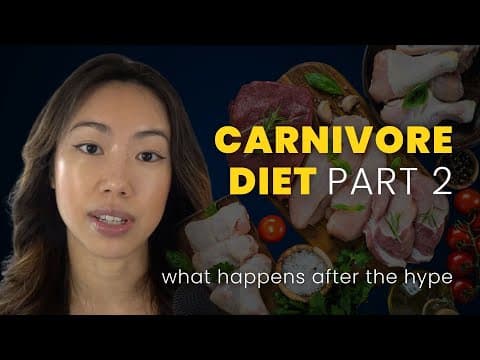
Carnivore Diet Part 2: Red Flags, Real Risks, and What Your Doctor Isn’t Saying
Aug 4, 2025

The $500M Performance Myth: What Tom Brady’s Former Chef Actually Fed Him
Mar 10, 2026

Stop Cooking With These: A Longevity Physician’s Guide to Seed Oils & Saturated Fat
Jan 17, 2026

Sugar vs Sweeteners: Best & Worst Options for Longevity (Science You Need to Know)
Sep 15, 2025