Vitamin D Is Not Useless. It Is Just Not Magic.
Vitamin D is an essential threshold nutrient, not a universal longevity drug. Failed prevention trials corrected the hype, but they did not make deficiency treatment useless.
Treat the threshold
Severe deficiency is real physiology. Once adequate, pushing the number higher has not delivered broad prevention benefits.
Test with a decision
Use total serum 25(OH)D when the result could change care. Routine screening is not useful for most healthy adults.
Keep the stack honest
D3 is the usual default. K2 is optional. Correct magnesium deficiency, but do not assume every D3 user needs magnesium.
The useful question is not simply, “Does vitamin D work?” It is whether vitamin D is the bottleneck for this person and this outcome.
Vitamin D began as a clear public-health success. Cod-liver oil, ultraviolet light, and fortification prevented or healed rickets. Later, low 25(OH)D became associated with cardiovascular disease, cancer, infection, depression, diabetes, autoimmunity, dementia, and mortality.
The problem is that low vitamin D also tracks winter, indoor life, higher adiposity, frailty, inflammation, lower activity, poorer diet, darker skin at high latitude, and kidney or liver dysfunction. A marker of a larger health context was often treated as the single cause.
Threshold disagreement and assay variability widened the diagnosis. In a same-specimen comparison, laboratories classified 12% to 41% of samples below 20 ng/mL. The assay-comparison study is a reminder that a seasonal continuous marker should not be treated as a perfect bright line.
A threshold nutrient, not a universal drug
VITAL gave more than 25,000 adults D3 2,000 IU/day or placebo. The measured subgroup began at a mean 25(OH)D of about 30.8 ng/mL. Cancer incidence, major cardiovascular events, fractures, and depression did not significantly improve. Those results corrected the hype. They did not show that 8 ng/mL and 28 ng/mL are physiologically equivalent.
1. Deficient
Missing substrate can impair mineralization and raise PTH.
2. Inadequate
Correction can restore a bottleneck.
3. Adequate
Normal physiology has enough substrate.
4. Diminishing returns
Higher levels have not produced broad prevention benefits.
5. Excess
Hypercalcemia, hypercalciuria, and kidney injury become concerns.
Order a test when the answer changes care
Use total serum 25-hydroxyvitamin D [25(OH)D]. It is the standard marker of vitamin D status and storage.
Do not use 1,25-dihydroxyvitamin D to screen for ordinary deficiency. It is tightly regulated by PTH, calcium, phosphate, kidney function, and other signals, and it can be normal or elevated when 25(OH)D is low. Reserve it for narrower questions such as unexplained hypercalcemia, granulomatous disease, selected lymphomas, advanced kidney disease, abnormal phosphate metabolism, or rare disorders.
Free or bioavailable vitamin D is scientifically interesting but is not standardized enough for routine use.
Reasonable reasons to test
- Osteomalacia, rickets, hypocalcemia, secondary hyperparathyroidism, osteoporosis, fragility fracture, or selected bone therapy planning
- Celiac disease, Crohn disease, pancreatic insufficiency, chronic diarrhea, other malabsorption, or bariatric surgery
- Chronic kidney or liver disease, abnormal calcium, phosphate, PTH, or alkaline phosphatase
- Granulomatous disease, sarcoidosis, lymphoma, unexplained hypercalcemia, stones, or hypercalciuria
- Relevant medicines, persistent nonresponse, or a dose high enough that the achieved level and calcium response matter
| Level | Common interpretation | Practical reading |
|---|---|---|
| Below 12 ng/mL | Deficient; associated with rickets or osteomalacia risk | Treat as a real low state and assess context. |
| 12 to below 20 ng/mL | Generally inadequate | Consider inputs, phenotype, symptoms, bone and mineral physiology. |
| 20 ng/mL or higher | Sufficient for most people for skeletal health | Do not assume a higher number adds longevity benefit. |
| 30 ng/mL or higher | Often used pragmatically in osteoporosis or higher-risk bone care | A context-specific target, not a universal goal. |
| Above 50 ng/mL | Possible adverse-effect zone | Review total intake and the calcium, kidney, and stone context. |
| Above 150 ng/mL | Toxicity territory, usually with hypercalcemia | Stop excess intake and seek clinical evaluation. |
Context labs when the result is low, high, or complicated
Calcium, creatinine/eGFR, PTH, phosphate, alkaline phosphatase when osteomalacia is plausible, magnesium when the risk pattern supports it, and urine calcium when stones, hypercalciuria, granulomatous disease, or higher-dose therapy matter. A vitamin D level is one part of the mineral system, not the whole diagnosis.
| Form | Best use | Clinical guardrail |
|---|---|---|
| D3 / cholecalciferol | Usual OTC default | Raises and maintains 25(OH)D effectively; take with a meal containing some fat. |
| D2 / ergocalciferol | Effective alternative, often prescribed | Works, including in 50,000-IU regimens, but is often less potent or durable than D3. |
| Calcifediol / 25-hydroxyvitamin D3 | Malabsorption, bariatric anatomy, liver disease, obesity with poor response, or faster correction | Raises 25(OH)D faster and more predictably. It is a pharmacologic tool, not an automatically superior wellness supplement. |
| Calcitriol | Selected CKD mineral-bone disease, hypoparathyroidism, and specific hypocalcemia states | Active hormone with greater hypercalcemia risk. It is not routine vitamin D repletion. |
- 01
No major risk factor
Meet the RDA through food, fortified foods, appropriate sun, or modest D3. Routine screening is usually unnecessary.
- 02
Low inputs are predictable
A daily 800 to 2,000 IU supplement can be reasonable. Test only if the result would change the plan.
- 03
Bone, mineral, absorption, kidney, liver, or treatment issue
Order total 25(OH)D and the context labs that answer the clinical question.
- 04
Result is low, high, or does not respond
Use a defined treatment and monitoring plan. Investigate physiology before escalating or stacking products.
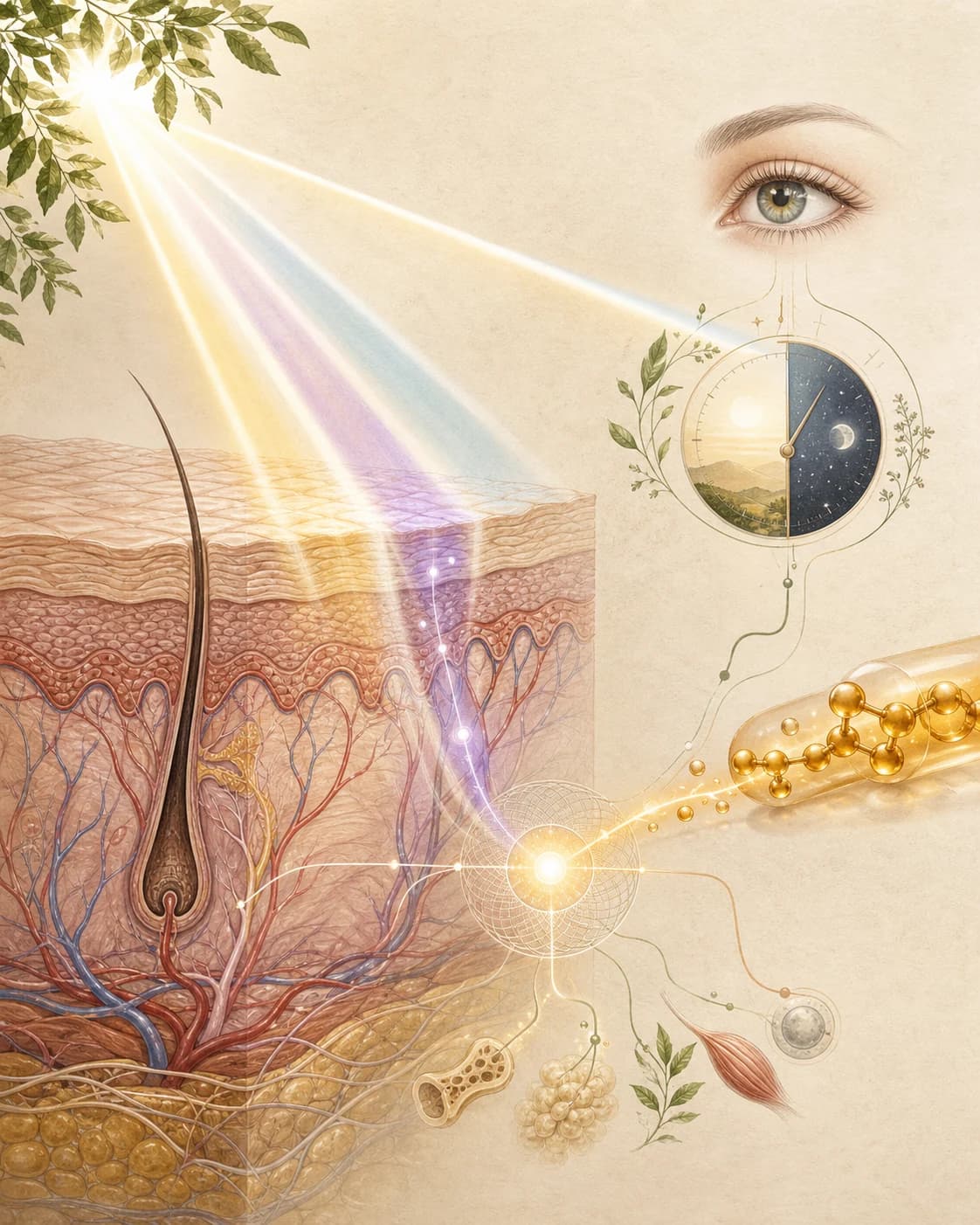
Separate UVB on skin from visible light at the eye
“Sunlight” bundles several exposures. A D3 pill can replace the vitamin D input. It cannot replace bright daytime retinal light, movement, outdoor time, or social context. The existence of other sunlight effects also does not make repeated unprotected UV a safe medical treatment.
UVB acts on uncovered skin to make vitamin D3. Visible light acts on the retina to support circadian timing. Oral vitamin D3 joins the skin pathway before liver and kidney metabolism but does not replace retinal light.
Skin pathway
UVB on uncovered skin
7-dehydrocholesterol becomes previtamin D3, then vitamin D3. The useful range is mainly 290 to 315 nm.
Oral D3 provides the same nutrient input without UV injury.
Eye pathway
Visible light at the retina
Rods, cones, and melanopsin-containing retinal cells help set circadian timing, alertness, and sleep-wake physiology.
A D3 capsule does not replace this signal. Normal outdoor viewing is enough. Never stare at the sun.
1. Skin or pill
Vitamin D3
2. Liver
25(OH)D
3. Kidney and tissues
Active signaling, regulated by physiology
290–315 nm
UVB
Established nutrient pathway
Acts on uncovered skin to make previtamin D3. Also causes erythema and DNA damage.
Visible
Retinal light
Established circadian pathway
Supports circadian timing and alerting through retinal photoreceptors. Direct sun-gazing is unnecessary.
315–400 nm
UVA / nitric oxide
Mechanistic human signal
Can release nitric-oxide activity and briefly lower blood pressure. Long-term net benefit is unproved; photoaging and cancer risk remain.
Red / NIR
Photobiomodulation
Parameter-specific and early
Controlled devices can have selected effects. Ordinary sunlight is not a standardized treatment, and broad longevity claims remain unproved.
| Source | What it provides | Main uncertainty | Best use |
|---|---|---|---|
| Sunlight | Can make D3 through UVB on uncovered skin | Variable by season, latitude, time, cloud, pigmentation, age, clothing, sunscreen, and behavior | Also includes retinal light and UV harms; not a reliable deficiency prescription |
| Food and fortified food | Steady background intake | Limited natural sources; fortification varies | Useful foundation without UV exposure |
| Oral D3 | Direct, measurable nutrient input | Adherence, absorption, body size, organ function, and product quality affect response | Usually the most controllable way to correct a known shortfall |
Sun is not reliably dosed
UVB near 290 to 315 nm converts epidermal 7-dehydrocholesterol to previtamin D3. Heat then yields D3. Skin-derived and oral D3 enter circulation differently at first, then feed the same liver and kidney pathways. There is no good human outcomes evidence that sun-made D3 is clinically superior.
Extended UV degrades excess precursors, which helps explain why sunlight does not usually cause vitamin D toxicity. That does not stop DNA damage or photoaging.
No fixed-minute prescription works across latitude, season, solar angle, cloud, haze, altitude, ozone, pigmentation, age, clothing, exposed area, sunscreen, and behavior. The classic Boston and Edmonton experiment found no meaningful winter previtamin D3 production for months.
A supplement is more predictable for deficiency
In a Seoul randomized trial, advice for 20 to 30 minutes of noon sun raised 25(OH)D 2.2 ng/mL more than placebo, while only 500 IU/day oral D3 raised it 8.5 ng/mL more. Only 12.2% of the sun group and 54.2% of the supplement group reached at least 20 ng/mL. Read the trial.
A Dutch trial in deficient immigrants also found a larger rise with 800 IU/day D3 than with advice for daily sun. Read the trial. Advice is not a controlled UV dose, but real-world adherence and variability are part of the practical problem.
Routine SPF 50+ use modestly lowered the 25(OH)D trajectory in the 2025 Sun-D trial. The response is to cover a nutrient gap with food, supplementation, or selective testing, not to deliberately accumulate UV injury. Read Sun-D.
Morning light, circadian timing, and ocular safety
Visible light at the eyes is the main environmental signal for the brain's circadian clock. Outdoor daylight is usually far brighter than indoor light, even under cloud. A small camping experiment increased daytime light more than fourfold and shifted melatonin timing roughly two hours earlier. Timing, intensity, spectrum, duration, and prior light history all change the response.
- Get outside after waking when feasible and seek substantial daytime light.
- Look normally at the environment, never the solar disk.
- Do not turn morning light into a universal five-, ten-, or thirty-minute dose.
- Bright visible light through a window can contribute to circadian exposure but does not make vitamin D.
- Dim light before sleep and keep the sleep environment dark.
Sun-gazing can cause solar retinopathy, blind spots, distortion, and permanent visual loss. A photo or visualization does not synthesize vitamin D or reproduce real retinal light. Light behind the knee failed replication as a circadian intervention. Solar retinopathy review.
Daily and modest usually beats dramatic
First distinguish total intake from supplement dose. The RDA assumes minimal sun exposure. Take D2 or D3 with a meal containing some fat. There is no reason to turn timing into a ritual.
| Amount | Typical context | Guardrail |
|---|---|---|
| 600 IU/day | RDA through age 70 | Total intake; assumes minimal sun exposure |
| 800 IU/day | RDA after age 70; common low-input maintenance | A total-intake reference, not a treatment dose |
| 1,000 to 2,000 IU/day | Common practical range for winter, indoor life, low diet, or other predictable low input | Often reasonable without ritualized timing |
| 2,000 to 4,000 IU/day | Selected deficiency or higher-risk settings | Have a reason and consider monitoring |
| 4,000 IU/day | Adult tolerable upper intake level for routine unsupervised use | Clinician-directed treatment may temporarily differ |
| 500,000 IU once yearly | Not routine care | Increased falls and fractures in an older-women trial; a bolus is not equivalent to the same daily average |
| Trial | Population and dose | Result | Correct interpretation |
|---|---|---|---|
| VITAL | 25,871 generally healthy adults; D3 2,000 IU/day; mean baseline 25(OH)D about 30.8 ng/mL in the measured subgroup | No significant reduction in invasive cancer or major cardiovascular events; ancillary fracture and depression results were neutral | Strong against blanket prevention in a mostly adequate population. It did not test prolonged severe deficiency well. |
| D-Health | 21,315 Australians age 60+; D3 60,000 IU monthly for up to 5 years | Did not reduce all-cause mortality in an unscreened older population | Supports skepticism about population-wide monthly dosing. It does not erase deficiency treatment, and monthly bolus exposure is not daily dosing. |
| VITAL fractures | Healthy midlife and older adults not selected for deficiency or osteoporosis | No reduction in total, nonvertebral, or hip fractures | Do not market D3 alone as universal fracture prevention. |
| VITAL-DEP | D3 2,000 IU/day | No reduction in incident or recurrent depression and no meaningful mood-score improvement | A low 25(OH)D association does not prove supplementation treats depression in adequate adults. |
| Annual megadose trial | Older women; 500,000 IU once yearly | More falls and fractures | Dose pattern matters. Prefer daily, modest dosing for routine use. |
Some secondary signals, including cancer mortality and autoimmune disease during active VITAL treatment, remain interesting. They are not strong enough to justify universal cancer or autoimmune prevention. The autoimmune signal did not persist after treatment stopped. A 2025 meta-analysis also found no statistically significant overall reduction in acute respiratory infections.
K2 and magnesium are not mandatory partners
Vitamin K2
Real target engagement, uncertain outcomes
K2 improves carboxylation biomarkers. Add-on trials have not reliably shown fewer fractures, less vascular calcification, fewer cardiovascular events, or protection from vitamin D toxicity.
Bottom line: optional for ordinary D3, never a safety antidote.
Magnesium
Essential physiology, not a universal add-on
Severe deficiency can suppress PTH, produce PTH resistance, and make calcium or vitamin D treatment appear ineffective. That does not mean every person taking D3 needs magnesium.
Bottom line: correct actual deficiency and low intake.
| Claim | Verdict | What the evidence supports |
|---|---|---|
| K2 directs calcium away from arteries | Biologically plausible, but too simple | K2 changes carboxylation biomarkers. Add-on trials have not reliably prevented fractures, calcification, cardiovascular events, hypercalcemia, hypercalciuria, or stones. |
| Everyone taking D3 needs K2 | Not established | K2 is optional for a healthy adult taking ordinary D3. Actual vitamin K deficiency, malabsorption, or specialist bone care is a different question. |
| Vitamin D is ineffective without magnesium | False as a universal claim | Severe magnesium deficiency can disrupt PTH and vitamin D physiology. Routine co-supplementation in magnesium-replete adults has not shown patient-important benefit. |
| Vitamin D depletes magnesium | Not shown in otherwise adequate adults | There is no validated D-to-magnesium ratio and no evidence magnesium makes excessive vitamin D safe. |
| RBC magnesium is the gold standard | Not established | Serum magnesium is accessible and useful when low. Every available magnesium test has limitations. |
Vitamin K2
Vitamin K carboxylates proteins including osteocalcin and matrix Gla protein. Vitamin D affects calcium and phosphate handling and can increase production of some K-dependent proteins. The interaction is plausible, but “D absorbs calcium and K2 directs it into bone” outruns the evidence.
In a three-year osteopenia trial, MK-7 375 mcg/day lowered undercarboxylated osteocalcin by 65% but did not improve BMD, bone microarchitecture, or trabecular bone score. AVADEC improved the K biomarker but not aortic-valve or coronary calcification overall.
MK-4 and MK-7 are not interchangeable. Japan's pharmacologic MK-4 osteoporosis dose is 45 mg/day, hundreds of times common nutritional MK-7 dosing. Actual deficiency risk is more relevant in fat malabsorption, cholestatic disease, bariatric anatomy, prolonged antibiotics, or specialist bone care.
Vitamin K can antagonize warfarin and other vitamin-K antagonists. Do not add K1 or K2 casually.
Magnesium
Magnesium participates in vitamin D metabolism, PTH secretion and action, and calcium handling. Severe deficiency can suppress PTH, create PTH resistance, contribute to hypocalcemia and hypokalemia, reduce 1,25(OH)2D production, and make treatment look ineffective.
The corrected Cheung trial details matter: 95 adults with overweight or obesity received placebo, D3 1,000 IU/day, or D3 1,000 IU/day plus 360 mg magnesium glycinate compound, supplying only 50.76 mg elemental magnesium. The combination had the largest within-group 25(OH)D rise, but its adjusted incremental difference from D3 alone was not statistically significant. PTH and inflammatory markers were also neutral. Read Cheung 2022.
Adult magnesium RDAs are 310 to 320 mg/day for women and 400 to 420 mg/day for men from food plus supplements. The US upper limit is 350 mg/day from supplements and medications, based mainly on diarrhea. It does not include food magnesium.
Food sources include seeds, nuts, beans, edamame, leafy greens, whole grains, and some mineral waters. Citrate, chloride, lactate, and aspartate tend to be more soluble than oxide. Glycinate is often tolerated, but its marketing is more confident than comparative outcome evidence.
When magnesium deserves closer attention
Prioritize magnesium assessment with documented low serum magnesium, difficult hypocalcemia or hypokalemia, inappropriately low or normal PTH in hypocalcemia, malabsorption or bariatric surgery, alcohol dependence, marked restriction, diabetes with renal loss, older age with low intake or polypharmacy, long-term proton-pump inhibitors, diuretics, aminoglycosides, cisplatin, calcineurin inhibitors, or an unexpectedly poor response.
Serum magnesium is accessible and useful when low, but a normal result does not perfectly exclude low stores. RBC magnesium, ionized magnesium, urine testing, and loading tests all have limits. In established hypomagnesemia, urine magnesium or fractional excretion can help distinguish renal from gastrointestinal loss.
Magnesium can accumulate in advanced CKD and can reduce absorption of tetracycline or fluoroquinolone antibiotics, oral bisphosphonates, levothyroxine, and other medicines. Separate doses according to the medication instructions or pharmacist guidance.
If the level does not rise, investigate before escalating
| Check | Why it matters |
|---|---|
| Adherence | Confirm the dose is taken consistently before increasing it. |
| Dose and product | Check IU on the label, duplicate products, expiration, and product credibility. |
| Meal timing | Take D2 or D3 with food containing some fat. |
| Baseline and body size | Higher adiposity can blunt the circulating response. |
| Absorption | Consider celiac disease, inflammatory bowel disease, pancreatic insufficiency, bariatric anatomy, and chronic diarrhea. |
| Liver and kidney physiology | Both organs participate in vitamin D metabolism; the correct form may change. |
| Medicines | Review antiseizure drugs, glucocorticoids, orlistat, bile-acid sequestrants, and other relevant agents. |
| Assay and season | A small shift can reflect method variability or season rather than a meaningful biologic change. |
| Magnesium and mineral pattern | Check when risk factors, hypocalcemia, hypokalemia, PTH, or treatment response makes magnesium deficiency plausible. |
Do not freestyle high doses
Some calcium and kidney phenotypes change the risk
Use clinician-directed dosing and monitoring with hypercalcemia, recurrent stones or hypercalciuria, sarcoidosis or another granulomatous disease, lymphoma, advanced CKD or CKD mineral-bone disease, primary hyperparathyroidism, hypoparathyroidism requiring active vitamin D, high-dose calcium plus thiazide therapy, complicated pregnancy mineral physiology, or possible toxicity.
Vitamin D toxicity usually presents through hypercalcemia and can cause nausea, weakness, confusion, dehydration, kidney injury, and arrhythmia. It is generally caused by excessive supplementation, not ordinary sun exposure.
Frequently asked questions
These answers address the claims that most often turn a nutrient decision into a sunlight or supplement mythology problem.
Is vitamin D useless if the big trials were negative?
No. The trials argue against vitamin D as universal chronic-disease prevention in mostly adequate adults. They do not erase deficiency physiology or the benefit of replacing a missing nutrient.
Should everyone get a vitamin D test?
No. Test when the result is likely to change management, or when bone disease, malabsorption, kidney or liver disease, medicines, calcium or PTH physiology, persistent nonresponse, or higher-dose treatment makes the answer useful.
Which vitamin D blood test should I order?
Use total serum 25-hydroxyvitamin D, written 25(OH)D. Do not use 1,25-dihydroxyvitamin D to screen for ordinary deficiency. The active hormone test belongs to narrower calcium, kidney, phosphate, granulomatous, lymphoma, and rare-metabolism questions.
Is 30 ng/mL the correct target?
It depends on context. At least 20 ng/mL is sufficient for most people by the National Academies framework. At least 30 ng/mL is often used in osteoporosis or other higher-risk bone care. There is no universal longevity target.
How much vitamin D should I take?
The adult RDA is 600 IU daily through age 70 and 800 IU after 70. If food and sun inputs are low, 800 to 2,000 IU daily is a common practical range. Doses from 2,000 to 4,000 IU may be used in selected higher-risk settings with a reason and monitoring. The adult tolerable upper intake level for routine unsupervised use is 4,000 IU daily.
Is D3 better than D2?
D3 usually raises and maintains 25(OH)D more effectively. D2 still works and is often used in prescription 50,000-IU preparations.
Should I take vitamin D with food?
Yes. Taking it with a meal containing some fat can improve absorption. There is no need to turn timing into a ritual.
How many minutes of sun do I need?
There is no universal number. UVB dose varies with latitude, season, time, cloud, altitude, pigmentation, age, clothing, exposed area, sunscreen, and behavior. Fixed-minute rules create false precision.
Is morning sunlight the best way to make vitamin D?
Usually not. Morning outdoor light can be useful for circadian timing because visible light reaches the eyes, but UVB is often weak when the sun is low. Midday makes vitamin D more efficiently per minute while also increasing UV damage.
Can sunlight through a window make vitamin D?
No meaningful amount. Ordinary glass blocks nearly all UVB. Bright visible window light can still affect circadian timing, and some UVA can pass through, but a window is not a vitamin D source.
Do clouds, winter, and latitude matter?
Yes. Cloud lowers and destabilizes UVB. At Boston's latitude, classic experiments found no meaningful winter previtamin D3 production from November through February, with a longer ineffective season in Edmonton. Overcast outdoor light can still be a strong circadian signal.
Does darker skin require more sunlight to make the same vitamin D?
Often, yes. Melanin reduces UVB penetration. Prescribing more unprotected UV is still imprecise and carries cumulative skin risk, so food, modest supplementation, and selective testing are more controllable tools.
Does sunscreen block vitamin D?
It can reduce skin synthesis. Real-world effects vary with SPF, application, clothing, and behavior. A 2025 trial found routine SPF 50+ use modestly lowered the 25(OH)D trajectory. Cover a gap with food, supplementation, or selective testing, not by abandoning skin-cancer prevention.
Do sunglasses prevent the circadian benefits of daylight?
They reduce retinal light exposure but do not usually eliminate it. Wear sunglasses for comfort, driving, work safety, or eye protection. There is no evidence-based reason to discard them or look toward the sun to optimize the clock.
Do I need to look directly at the sun?
No. Look normally at the outdoor environment. Direct sun-gazing is unnecessary and can injure the macula, causing blind spots, distortion, or permanent visual loss. Ordinary sunglasses are not solar-viewing filters.
Can I wash vitamin D off by showering after sun exposure?
No. Vitamin D synthesis begins inside living epidermal cells, not in surface oil waiting to be absorbed. Soap and water do not wash it away.
Can a tanning bed correct vitamin D deficiency?
Some devices emit UVB and can raise vitamin D, but the dose is poorly controlled and the radiation is carcinogenic. Indoor tanning is not an appropriate vitamin D treatment.
Is sun-made vitamin D better than supplement-made vitamin D?
No clinically important superiority has been shown. Entry into circulation differs at first, but both provide D3 to the same downstream 25-hydroxylation pathway. Sunlight has other effects, both useful and harmful, but its vitamin D molecule is not special.
What about vitamin D sulfate from sunlight?
25(OH)D sulfate is a real metabolite formed mainly through a liver enzyme. That does not show that sunlight uniquely creates a superior water-soluble vitamin D, that supplements cannot support sulfated metabolites, or that oral D3 causes sulfate deficiency or arterial calcification.
Can a picture of the sun or visualizing sunlight work?
Not for vitamin D and not as a demonstrated circadian substitute. Vitamin D requires UVB on skin. Circadian timing responds to real photons reaching the retina. A bright screen has ordinary light effects, but the picture or belief is not the active ingredient.
Can light behind the knee, on the abdomen, or on other skin set the body clock?
Not on current human evidence. A famous light-behind-the-knee result was not reproduced. Use light reaching the eyes for circadian timing. That is separate from UVB on skin and from experimental red or near-infrared tissue effects.
Does UVA release nitric oxide and lower blood pressure?
A small human experiment found short-lived vasodilation and a modest blood-pressure reduction after UVA exposure. That is a mechanistic signal, not evidence that intentional UVA prevents cardiovascular events or has a favorable net benefit after photoaging and skin-cancer risk.
Does sunlight boost testosterone or reproductive hormones?
This is not ready for health advice. A widely shared paper was mainly mechanistic mouse work, with limited human seasonal and questionnaire data. It does not establish UVB as a safe testosterone, fertility, libido, or menopause therapy.
What about red or near-infrared sunlight for mitochondria?
Photobiomodulation is a legitimate research field, but outcomes depend on wavelength, irradiance, dose, tissue, device, and indication. A small exploratory 2025 study does not show that morning infrared charges mitochondria or extends life, and it does not cancel UV risk.
Do I need K2 with D3?
Usually not. K2 changes vitamin-K-dependent biomarkers, but routine add-on use has not been shown to prevent fractures, vascular calcification, heart attacks, or vitamin D toxicity. Do not add it casually with warfarin or another vitamin-K antagonist.
Do I need magnesium with D3?
Not automatically. Magnesium is required for normal vitamin D, PTH, and calcium physiology. Correct low intake or deficiency when present. Extra magnesium has not been shown to unlock additional vitamin D benefits in magnesium-replete people.
Does vitamin D deplete magnesium?
Routine vitamin D supplementation has not been shown to cause clinically important magnesium depletion in otherwise adequate adults. There is no validated vitamin-D-to-magnesium ratio.
Is RBC magnesium better than serum magnesium?
Not clearly enough for routine screening. Serum magnesium is imperfect but clinically accessible. RBC magnesium, ionized magnesium, urine testing, and loading tests also have limitations; no single test is a universal wellness gold standard.
Can K2 or magnesium make a high vitamin D dose safe?
No. Neither is an antidote to excess vitamin D. Lower the dose, stop stacking products, and evaluate calcium, kidney function, stones, urine calcium, and symptoms when clinically relevant.
What changes with kidney disease?
Advanced kidney disease changes calcium, phosphate, PTH, and vitamin D activation. Calcitriol or other active forms may be used for specific CKD mineral-bone indications, but they are not routine repletion. Do not self-treat with high-dose vitamin D, calcitriol, K2, or magnesium in advanced CKD.
What changes during pregnancy?
Pregnancy is one group for which the 2024 Endocrine Society guideline supports empiric vitamin D intake without routine testing. Standard prenatal intake may be reasonable, but higher doses and any abnormal calcium, kidney, stone, parathyroid, or malabsorption physiology should be individualized with the obstetric clinician.
References and citations
- 01NIH Office of Dietary Supplements: Vitamin D Fact Sheet for Health Professionals
- 02Endocrine Society 2024 vitamin D prevention guideline
- 03USPSTF 2021: Vitamin D Deficiency in Adults, Screening
- 04Manson et al. VITAL cancer and cardiovascular outcomes, NEJM 2019
- 05LeBoff et al. VITAL fracture outcomes, NEJM 2022
- 06Okereke et al. VITAL-DEP, JAMA 2020
- 07Neale et al. D-Health all-cause mortality trial
- 08Jolliffe et al. 2025 acute respiratory infection meta-analysis
- 09Sanders et al. Annual high-dose vitamin D, falls, and fractures
- 10Black et al. Vitamin D assay bias and classification variability
- 11Tripkovic et al. D2 versus D3 systematic review
- 12Webb et al. Season, latitude, and cutaneous vitamin D synthesis
- 13Wicherts et al. Sunlight advice versus oral D3 in deficiency
- 14Joh et al. Noon sun versus oral D3 randomized trial
- 15Neale et al. 2025 Sun-D sunscreen randomized trial
- 16Wright et al. Natural light-dark cycle and circadian timing
- 17Brown et al. Consensus recommendations for daytime and nighttime light
- 18Liu et al. UVA, nitric oxide activity, and acute blood pressure
- 19Jourieh. Solar retinopathy review
- 20Wong et al. Human 25(OH)D sulfate metabolism
- 21Parikh et al. UVB skin-brain-gonad signaling study
- 22Jeffery et al. Exploratory 850-nm tissue exposure study
- 23Wright and Czeisler. Failed extraocular circadian-light replication
- 24Rønn et al. MK-7 add-on trial in osteopenia
- 25Diederichsen et al. AVADEC vitamin K2 and D trial
- 26Mott et al. Vitamin K, bone density, and fractures review
- 27NIH Office of Dietary Supplements: Magnesium Fact Sheet
- 28Rude et al. PTH resistance in human magnesium deficiency
- 29Dai et al. Magnesium and vitamin D metabolite trial
- 30Cheung et al. Magnesium plus vitamin D randomized trial
Review notes
- Reviewed by:
- Hillary Lin, MD
- Updated:
- July 12, 2026
- Conflicts:
- No supplement store. No affiliate ranking. Educational, not personal medical advice.