Milk vs Plant Milk: Which One Should You Buy?
Whole cow's milk is a reasonable baseline if you tolerate it and its calories and saturated fat fit your diet. For a dairy-free option that preserves protein, start with fortified unsweetened soy milk or a label-verified pea milk, then compare protein, added sugar, fortification, saturated fat, and how you will use it.
Use a baseline
Whole milk provides about 8 grams of complete protein per cup plus a predictable set of micronutrients. Compare replacements against what you want to change and preserve.
Preserve protein
Fortified unsweetened soy and some protein-formulated pea milks are the closest plant options when a full cup needs to contribute meaningful protein.
Read for the use
Protein and fortification matter for a primary beverage. Taste and texture can matter more when the amount is a small splash in coffee.
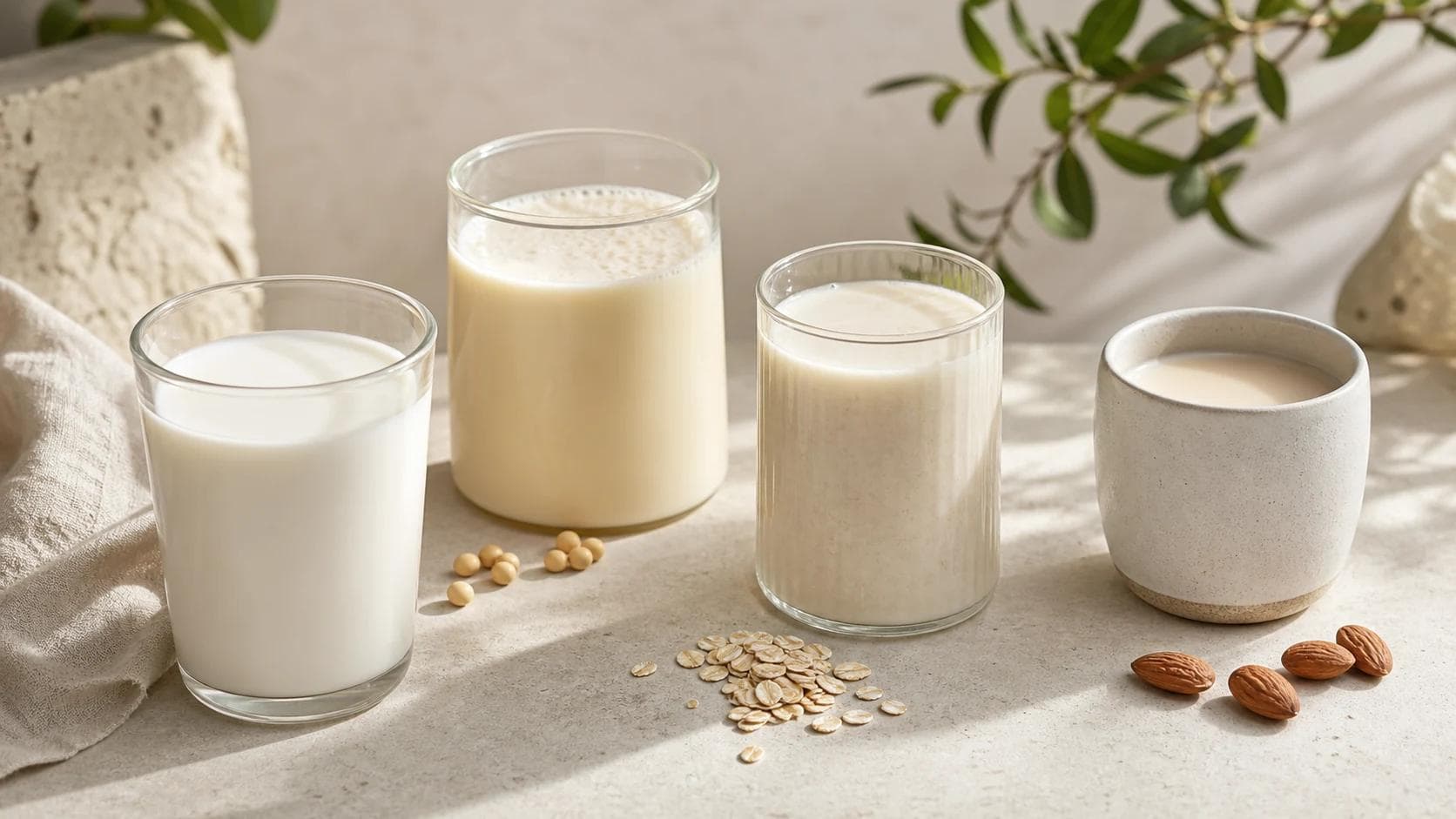
The answer and the whole-milk baseline
Replacing whole milk with almond milk can reduce protein from about 8 grams to 1 gram per cup. Fortified soy milk may provide nearly as much protein as whole milk. All three are marketed for many of the same uses, but their nutrient profiles are different.
How much that difference matters depends on how the product is used. It can be important at breakfast, in a child's diet, or for someone with limited appetite. It matters less in a small amount added to coffee.
I use whole cow's milk as the reference because it defines the conventional nutrient profile. One cup has roughly 150 calories and 5 grams of saturated fat, along with complete protein, calcium, potassium, riboflavin, vitamin B12, and usually added vitamin D. It also contains lactose and cow's-milk proteins.
From that baseline, the comparison is specific. Lactose-free milk changes the lactose. Lower-fat milk reduces fat and calories. Ultrafiltered milk increases protein concentration. A2 milk changes the beta-casein composition. Plant milks may differ from whole milk across almost every major nutrient.
Whole cow's milk is a reasonable choice if you tolerate it and its calories and saturated fat suit the rest of your diet. The best alternative depends on what you want to change and what you want to preserve.
Reaction-first decision path
Start with the reaction. Then choose the nutrition.
Start with safety. This figure sorts the next question; it does not diagnose the cause.
Start here
What happens when you drink dairy?
Branch A
Possible allergic reaction
Hives, facial or throat swelling, wheeze, repetitive vomiting, faintness, or rapid whole-body symptoms can signal allergy.
Stop the product experiment
Do not trial dairy at home after a severe or immediate reaction.
Breathing or throat symptoms, faintness, or an anaphylaxis-type reaction warrant emergency care.
Blocked candidates
Lactose-free, ultrafiltered, A2, goat, and sheep milk still contain mammalian milk proteins.
Use an allergy pathway. Plant products avoid cow's-milk protein but may contain soy, tree-nut, or pea allergens.
Branch B
GI symptoms only
In adults, mild gas, bloating, cramps, or diarrhea after lactose-containing dairy can fit lactose intolerance. GI-only symptoms do not rule out delayed allergy.
Test lactose in the right context
An adult with mild, dose-linked symptoms and no immediate or delayed allergy features may try lactose-free dairy.
Know when not to test at home
Infants and children, or anyone with persistent vomiting, blood in stool, poor growth, dysphagia, or severe or chronic diarrhea, need clinical evaluation.
A2 comes later, if at all
A2 is a later option only for an adult without allergy features. It still contains lactose and milk proteins; benefit is uncertain.
Branch C
No tolerance problem
Choose by the nutritional role the product needs to fill, then compare the finished labels.
Meaningful daily nutrition or high protein
Compare dairy, fortified soy, and label-verified pea milk. Ultrafiltered dairy adds more protein.
Lower saturated fat or fully plant-based
Compare lower-fat dairy with fortified unsweetened soy or low-saturated-fat pea milk.
Coffee or cooking
Choose for taste and texture. Check added sugar and saturated fat when the serving is more than a splash.
Mild, classic lactose symptoms in an adultLactose-free cow's milk preserves the basic nutrient profile without lactose.
Less saturated fat or fewer caloriesConsider lower-fat dairy, unsweetened soy milk, or a low-saturated-fat pea milk.
Dairy-free with similar proteinFortified unsweetened soy milk is the most consistent option. Some pea-protein milks are also comparable.
More proteinCompare ultrafiltered dairy, soy, and protein-fortified pea milk.
Possible intolerance despite tolerating lactose: A2 milk can be tried after lactose intolerance has been addressed. Evidence for better tolerance is mixed.
Coffee or cookingChoose based on taste and texture. A small amount contributes little protein or calcium.
Milk vs plant milk: quick comparison
The FDA recommends comparing milk and plant-based beverages by protein, calcium, vitamin D, potassium, saturated fat, and added sugar. Category averages are useful for orientation, but formulations vary by product.
Protein per cup
Protein per cup varies across milk options
These ranges orient the comparison. Formulations vary, so use the protein line on the Nutrition Facts panel for the product you buy.
Whole milk
Reference amount
About 8 g
Fortified soy
Range varies by formula
7 to 9 g
Protein-formulated pea
Verify the finished product
About 7 to 10 g
Oat
Most are not protein replacements
Usually 0 to 3 g
Almond
Many provide about 1 g
Usually 0 to 3 g
Quick comparison
Whole cow's milk
- Protein compared with whole milk
- About 8 g per cup
- Main difference
- Contains lactose and about 5 g saturated fat
- Common use
- General use when dairy is tolerated
Lower-fat cow's milk
- Protein compared with whole milk
- About the same
- Main difference
- Less fat, saturated fat, and calories
- Common use
- Dairy nutrition with less saturated fat
Lactose-free cow's milk
- Protein compared with whole milk
- About the same
- Main difference
- Lactose is broken down
- Common use
- Lactose intolerance without milk-protein allergy
Ultrafiltered milk
- Protein compared with whole milk
- Usually higher
- Main difference
- More concentrated protein; often less lactose or carbohydrate
- Common use
- Higher-protein meals and limited appetite
A2 milk
- Protein compared with whole milk
- About the same
- Main difference
- Contains only A2 beta-casein; still contains lactose
- Common use
- Individual tolerance trial
Goat or sheep milk
- Protein compared with whole milk
- Roughly comparable
- Main difference
- Contains lactose; mammalian milk proteins commonly cross-react
- Common use
- Flavor or culinary preference, not a milk-allergy substitute
Fortified soy milk
- Protein compared with whole milk
- Often 7 to 9 g
- Main difference
- Dairy-free; fortification varies
- Common use
- Closest mainstream plant comparison
Pea-protein milk
- Protein compared with whole milk
- Can be similar
- Main difference
- Dairy-free and soy-free; formulation varies
- Common use
- Higher-protein plant-based diets
Oat milk
- Protein compared with whole milk
- Usually much lower
- Main difference
- More carbohydrate; creamy texture
- Common use
- Coffee, cereal, and cooking
Almond and other nut milks
- Protein compared with whole milk
- Usually much lower
- Main difference
- Often lower in calories; fortification varies
- Common use
- Coffee, smoothies, and cooking
Coconut or rice milk
- Protein compared with whole milk
- Usually much lower
- Main difference
- Coconut can be high in saturated fat; rice is high in carbohydrate
- Common use
- Specific flavor, cooking, or allergy needs
| Option | Protein compared with whole milk | Main difference | Common use |
|---|---|---|---|
| Whole cow's milk | About 8 g per cup | Contains lactose and about 5 g saturated fat | General use when dairy is tolerated |
| Lower-fat cow's milk | About the same | Less fat, saturated fat, and calories | Dairy nutrition with less saturated fat |
| Lactose-free cow's milk | About the same | Lactose is broken down | Lactose intolerance without milk-protein allergy |
| Ultrafiltered milk | Usually higher | More concentrated protein; often less lactose or carbohydrate | Higher-protein meals and limited appetite |
| A2 milk | About the same | Contains only A2 beta-casein; still contains lactose | Individual tolerance trial |
| Goat or sheep milk | Roughly comparable | Contains lactose; mammalian milk proteins commonly cross-react | Flavor or culinary preference, not a milk-allergy substitute |
| Fortified soy milk | Often 7 to 9 g | Dairy-free; fortification varies | Closest mainstream plant comparison |
| Pea-protein milk | Can be similar | Dairy-free and soy-free; formulation varies | Higher-protein plant-based diets |
| Oat milk | Usually much lower | More carbohydrate; creamy texture | Coffee, cereal, and cooking |
| Almond and other nut milks | Usually much lower | Often lower in calories; fortification varies | Coffee, smoothies, and cooking |
| Coconut or rice milk | Usually much lower | Coconut can be high in saturated fat; rice is high in carbohydrate | Specific flavor, cooking, or allergy needs |
Compare the finished product, not only the category name. Protein, fortification, oils, sodium, and added sugar can differ substantially.
Why I have tried nearly every kind of milk
I grew up drinking cow's milk in several fat percentages. It probably supplied a meaningful share of my childhood protein and micronutrients. In my teens, I switched heavily to soy milk and soon began having lactose-intolerance symptoms.
My tolerance improved in my 20s as I gradually reintroduced dairy. That does not necessarily mean intestinal lactase returned. Regular lactose exposure can reduce symptoms in some people through colonic adaptation, although the response varies. A 2019 review distinguishes fixed intestinal lactase activity from an adaptable colonic microbiome.
Since then, I have tried oat, almond, pea, macadamia, walnut, hazelnut, and pistachio milks; minimal-ingredient nut milks; barista blends; two-ingredient products; creamers; and, briefly, mushroom powder in coffee. For my current body-composition goals, I usually choose ultrafiltered dairy for its higher protein-to-sugar ratio.
I am not loyal to dairy or plant milk as a category. I choose based on the nutrition label, tolerance, and how I plan to use it.
Lactose, A2, goat milk, and milk-protein allergy
Lactose intolerance and milk-protein allergy are different problems. Lactose intolerance is carbohydrate malabsorption. Milk-protein allergy is an immune reaction. A product name that changes one feature of dairy does not erase the others.
For an adult with mild, dose-linked gas, bloating, cramping, or diarrhea and no immediate or delayed allergy features, lactose-free cow's milk can be a reasonable first trial. Infants and children, or anyone with persistent vomiting, blood in stool, poor growth, dysphagia, or severe or chronic diarrhea, need clinical evaluation rather than a home test.
A2 milk changes one beta-casein variant, not lactose, whey, or the whole milk-protein profile. Some randomized studies report fewer digestive symptoms, but results are inconsistent. A 2026 randomized pilot found no significant difference in overall gastrointestinal symptoms, intestinal transit, or laboratory measures. Try lactose-free milk first when lactose intolerance is plausible.
Goat and sheep milk can be chosen for taste or cooking when tolerated, but both contain lactose and related mammalian milk proteins. In a controlled challenge study, 24 of 26 children with IgE-mediated cow's-milk allergy also reacted to goat milk.
What the label changes, and what it does not
Lactose-free cow's milk
- Lactose
- Broken down with lactase
- Milk proteins or allergens
- Cow's-milk proteins remain
- Useful role
- First nutrition-preserving option for lactose symptoms
- Limitation
- Not safe for cow's-milk protein allergy
A2 cow's milk
- Lactose
- Still present
- Milk proteins or allergens
- Cow's-milk proteins remain; A2 beta-casein replaces A1
- Useful role
- Optional later tolerance trial after lactose is addressed
- Limitation
- Not hypoallergenic; digestive-benefit evidence is mixed
Goat or sheep milk
- Lactose
- Still present
- Milk proteins or allergens
- Mammalian milk proteins commonly cross-react with cow's milk
- Useful role
- Food choice for taste or cooking when tolerated
- Limitation
- Not a safe substitute for cow's-milk protein allergy
Fortified plant milk
- Lactose
- Usually absent; check the label
- Milk proteins or allergens
- No cow's-milk protein, but may contain soy, tree-nut, or pea allergens
- Useful role
- Dairy-free option; soy or pea can preserve protein
- Limitation
- Protein and fortification vary; allergen review is still necessary
| Product | Lactose | Milk proteins or allergens | Useful role | Limitation |
|---|---|---|---|---|
| Lactose-free cow's milk | Broken down with lactase | Cow's-milk proteins remain | First nutrition-preserving option for lactose symptoms | Not safe for cow's-milk protein allergy |
| A2 cow's milk | Still present | Cow's-milk proteins remain; A2 beta-casein replaces A1 | Optional later tolerance trial after lactose is addressed | Not hypoallergenic; digestive-benefit evidence is mixed |
| Goat or sheep milk | Still present | Mammalian milk proteins commonly cross-react with cow's milk | Food choice for taste or cooking when tolerated | Not a safe substitute for cow's-milk protein allergy |
| Fortified plant milk | Usually absent; check the label | No cow's-milk protein, but may contain soy, tree-nut, or pea allergens | Dairy-free option; soy or pea can preserve protein | Protein and fortification vary; allergen review is still necessary |
Lactose and milk protein are different. A lactose claim does not make a cow, goat, or sheep product hypoallergenic.
Soy, pea, and the closest plant options
Fortified unsweetened soy milk is the closest mainstream plant-based option. It often provides 7 to 9 grams of protein per cup and may be fortified with calcium, vitamin D, and B12. Some pea-protein milks also provide protein amounts comparable with cow's milk. Fortification, sodium, oils, and added sugar vary more by product.
Soy milk has the strongest evidence base among common plant milks. A 2024 systematic review and meta-analysis included 17 randomized trials. Replacing cow's milk with soy milk did not worsen the cardiometabolic markers studied and improved several of them. The trials were generally small and short and measured biomarkers rather than heart attacks or lifespan.
Concerns that normal soy intake feminizes men are not supported by clinical trials. A 2021 meta-analysis found no effect of soy or isoflavone exposure on total testosterone, free testosterone, estradiol, or estrone in men.
Soy allergy remains relevant. People taking levothyroxine should use consistent medication timing around food, including soy.
Pea-protein milk can provide protein comparable with dairy or soy without containing either allergen. Other pea products contain much less. Check protein, calcium, vitamin D, B12, sodium, added sugar, and serving size.
Oat, nut, coconut, rice, and seed milks
Oat milk is popular for its creamy texture and performance in coffee. Most products contain less protein and more carbohydrate than dairy or soy. Barista versions may include oil, and sweetened products may contain substantial added sugar. Whole oats can lower LDL cholesterol when they provide enough beta-glucan, but oat milk may contain much less beta-glucan than the amounts used in clinical studies. Check fiber rather than assuming oat milk has the same effect as oatmeal or oat bran.
Unsweetened almond, cashew, macadamia, and other nut milks can be low-calorie options for coffee, smoothies, cereal, or cooking. Most provide little protein. Calcium, vitamin D, B12, and other fortification vary. They work well when protein and micronutrients come from the rest of the meal. A short ingredient list does not make a low-protein product nutritionally equivalent to milk.
Refrigerated coconut beverage and canned coconut milk are different products. Both are low in protein. Canned coconut milk is concentrated and can provide substantial saturated fat. Use it for flavor and cooking, and include its saturated fat when evaluating a diet for high LDL-C or ApoB.
Rice milk can be useful when dairy, soy, and nuts are excluded. It is usually high in carbohydrate and low in protein. Frequent rice-product intake also raises arsenic concerns, particularly in young children. I would not use rice milk as a child's primary milk without a specific nutrition plan.
Hemp, flax, chia, and other seed milks may provide alpha-linolenic acid, depending on the formula. Protein and fortification vary substantially. Review the finished product rather than assuming its nutrient profile matches the seed used to make it.
Minimal-ingredient nut milks made from nuts, water, and salt may suit people who prefer fewer additives. Many contain little protein and no fortification. They can work for coffee or cooking when the rest of the diet supplies the missing nutrients. They are not nutritionally comparable with whole milk.
How to read a milk label
Check the Nutrition Facts panel in a consistent order. The amount of scrutiny should match the amount and purpose of the drink.
Milk label checklist
Protein
- What to look for
- About 7 to 10 g per cup when the drink is part of a meal
- Why
- Whole milk provides about 8 g; many plant milks provide little
Added sugar
- What to look for
- Little or none in a daily beverage
- Why
- Sweetened and barista products can add significant sugar
Calcium
- What to look for
- A substantial amount when dairy is excluded
- Why
- Fortification varies and may settle in the container
Vitamin D
- What to look for
- Verify the amount
- Why
- Plant-milk fortification is not standard
Vitamin B12
- What to look for
- Check carefully in fully plant-based diets
- Why
- Many minimal-ingredient products omit it
Iodine
- What to look for
- Check ingredients or manufacturer information when relevant
- Why
- Many plant milks are not iodine-fortified
Saturated fat
- What to look for
- Compare when LDL-C or ApoB is high
- Why
- Whole dairy and coconut products may provide more
Sodium
- What to look for
- Compare similar products
- Why
- Protein-fortified and barista products may be high in sodium
Serving size
- What to look for
- Confirm that values are listed per cup
- Why
- A small amount in coffee differs from a full glass
| Check | What to look for | Why |
|---|---|---|
| Protein | About 7 to 10 g per cup when the drink is part of a meal | Whole milk provides about 8 g; many plant milks provide little |
| Added sugar | Little or none in a daily beverage | Sweetened and barista products can add significant sugar |
| Calcium | A substantial amount when dairy is excluded | Fortification varies and may settle in the container |
| Vitamin D | Verify the amount | Plant-milk fortification is not standard |
| Vitamin B12 | Check carefully in fully plant-based diets | Many minimal-ingredient products omit it |
| Iodine | Check ingredients or manufacturer information when relevant | Many plant milks are not iodine-fortified |
| Saturated fat | Compare when LDL-C or ApoB is high | Whole dairy and coconut products may provide more |
| Sodium | Compare similar products | Protein-fortified and barista products may be high in sodium |
| Serving size | Confirm that values are listed per cup | A small amount in coffee differs from a full glass |
Shake fortified plant milk before pouring because added calcium may settle.
School-meal benchmarkThe USDA standard for a nondairy substitute includes 8 grams of protein and 276 mg of calcium per cup, plus vitamin A, vitamin D, magnesium, phosphorus, potassium, riboflavin, and B12.
Primary beverageA drink does not need to meet the school standard for every use. If it will be a person's primary milk, nutrients missing from the product must come from other foods or supplements.
Oils and gumsOils improve texture, and gums or stabilizers limit separation. Neither is inherently harmful at the amounts typically used. Choose another product if a specific ingredient repeatedly causes symptoms. Protein, added sugar, saturated fat, and fortification are usually more important.
When milk choice has higher stakes
High LDL-C or ApoB: Compare saturated fat across whole milk, lower-fat dairy, soy, pea, and coconut products. Consider the rest of the diet rather than attributing the lipid pattern to one food. After a substantial dietary change intended to lower LDL-C or ApoB, repeat the relevant labs to assess the response.
Allergy or unexplained symptoms: Use the reaction-first path above. GI-only symptoms do not diagnose lactose intolerance or rule out allergy, and severe or immediate reactions should not be tested at home.
Raw milk: I do not recommend it. Pasteurization preserves the main nutritional value while reducing preventable exposure to Campylobacter, Cryptosporidium, E. coli, Listeria, Brucella, Salmonella, and other pathogens.
Pregnancy, preconception, and fully plant-based diets: Protein, B12, calcium, vitamin D, and iodine require deliberate attention. Cow's milk provides meaningful iodine in many U.S. diets, while many plant milks are not iodine-fortified. A 2024 prenatal-nutrition review describes the risk of iodine insufficiency when dairy milk is replaced with an unfortified plant beverage. A diet without dairy can meet nutritional needs, but the nutrients previously supplied by dairy still need to be accounted for.
Children: A low-protein, unfortified plant beverage is not nutritionally equivalent to cow's milk. Age, growth, allergy, the rest of the diet, and the exact product all affect the choice. Cow's milk and plant beverages are not substitutes for infant formula. Choose a child's primary milk with pediatric guidance.
Older adults, athletes, and people with limited appetite: When appetite is limited, a low-protein beverage should not be counted as a meaningful protein source. Dairy, soy, and protein-fortified pea milk provide more protein per cup. Almond or oat milk can still be used in a smoothie that already contains yogurt, whey, soy, pea protein, or another substantial protein source.
Kidney disease or a medically restricted diet: Potassium, phosphorus, protein, sodium, and additives may affect the choice. Use the person's kidney function, laboratory results, medications, and treatment plan. Heavy fortification is not always desirable.
My recommendations by situation
These are starting options, not universal prescriptions. The rest of the diet, the amount consumed, tolerance, allergy, age, and medical context still matter.
Starting options by situation
No problem with dairy, calories, or saturated fat
- Starting option
- Whole cow's milk
Mild, classic lactose symptoms in an adult
- Starting option
- Lactose-free cow's milk
Dairy nutrition with less saturated fat
- Starting option
- Lower-fat cow's milk
Dairy-free with substantial protein
- Starting option
- Fortified unsweetened soy milk or a label-verified pea milk
Higher-protein breakfast or limited appetite
- Starting option
- Ultrafiltered dairy, soy, or a protein-fortified pea milk
Coffee or cooking
- Starting option
- Choose by taste; check sugar and saturated fat when using larger amounts
High LDL-C or ApoB
- Starting option
- Lower-fat dairy or a low-saturated-fat soy or pea option within the full diet
Fully plant-based diet
- Starting option
- Fortified soy or pea milk, with deliberate B12 and iodine planning
Milk for a child
- Starting option
- Age- and growth-appropriate choice with pediatric guidance
Raw milk marketed as healthier
- Starting option
- Pasteurized milk
| Situation | Starting option |
|---|---|
| No problem with dairy, calories, or saturated fat | Whole cow's milk |
| Mild, classic lactose symptoms in an adult | Lactose-free cow's milk |
| Dairy nutrition with less saturated fat | Lower-fat cow's milk |
| Dairy-free with substantial protein | Fortified unsweetened soy milk or a label-verified pea milk |
| Higher-protein breakfast or limited appetite | Ultrafiltered dairy, soy, or a protein-fortified pea milk |
| Coffee or cooking | Choose by taste; check sugar and saturated fat when using larger amounts |
| High LDL-C or ApoB | Lower-fat dairy or a low-saturated-fat soy or pea option within the full diet |
| Fully plant-based diet | Fortified soy or pea milk, with deliberate B12 and iodine planning |
| Milk for a child | Age- and growth-appropriate choice with pediatric guidance |
| Raw milk marketed as healthier | Pasteurized milk |
Sustainability and the clinical bottom line
Plant milks generally require less land and produce fewer greenhouse-gas emissions than dairy milk. Environmental effects vary by crop and supply chain. Almond production uses substantial water. Rice production generates methane and carries an arsenic concern. Coconut supply chains raise labor and ecological issues. Packaging, transport, farming practices, and food waste also contribute.
Environmental priorities may affect the choice, but they do not change the nutrient content of the product.
Whole cow's milk is the reference in this guide. It is a reasonable option for people who tolerate it and whose diet can accommodate its calories and saturated fat.
If you choose another product, identify the reason. Lactose-free milk addresses lactose intolerance. Lower-fat dairy reduces saturated fat. Fortified soy and some pea milks preserve much of the protein while excluding dairy. Oat and nut milks often provide less protein and are better suited to taste, texture, or culinary use.
Check the label for protein, added sugar, calcium, vitamin D, B12, iodine, saturated fat, sodium, and serving size.
Frequently Asked Questions
What is the healthiest milk to drink?
There is no single healthiest milk. Whole cow's milk is reasonable for people who tolerate it and can accommodate its calories and saturated fat. Lactose-free milk suits lactose intolerance. Lower-fat dairy may be preferable for high LDL-C or ApoB. Fortified soy and some pea milks are the most comparable dairy-free options when protein is important.
Is plant milk healthier than cow's milk?
It depends on the product and the reason for choosing it. Unsweetened soy or pea milk may provide less saturated fat with similar protein. Almond or oat milk may provide fewer calories or a preferred taste but usually less protein.
Which plant milk has the most protein?
Fortified soy milk and protein-formulated pea milk usually come closest to cow's milk. Look for approximately 7 to 10 grams per cup. Many almond, oat, coconut, rice, and minimalist nut milks provide 0 to 3 grams.
Is soy milk nutritionally comparable with cow's milk?
Fortified unsweetened soy milk is the closest mainstream plant-based comparison. It often approaches cow's milk in protein and may include calcium, vitamin D, and B12. Fortification varies by product.
Is oat milk healthier than cow's milk?
Oat milk usually contains less protein and more carbohydrate than cow's milk. It may work well for coffee and cooking. Its beta-glucan content may be much lower than the amounts used in studies of whole oats or oat bran.
Is almond milk healthier than cow's milk?
Unsweetened almond milk is often lower in calories but usually contains little protein. It is reasonable when the rest of the meal supplies enough protein and micronutrients.
Is whole milk healthier than 2% or skim milk?
The protein and core micronutrients are similar. Whole milk provides more calories and saturated fat. The best choice depends on age, appetite, the rest of the diet, and LDL-C or ApoB response.
Is A2 milk better for lactose intolerance?
No. A2 milk still contains lactose. Try lactose-free milk first when lactose intolerance is likely. A2 milk may be considered later for persistent digestive symptoms, but evidence for benefit is mixed.
Is goat milk safe if I am allergic to cow's milk?
Usually no. Goat and sheep milk proteins are similar to cow's-milk proteins and commonly cross-react. They are not safe substitutes for cow's-milk protein allergy unless an allergy specialist has evaluated the specific situation.
Does lactose-free or A2 milk still contain milk protein?
Yes. Lactose-free cow's milk changes the lactose, not the milk proteins. A2 milk is cow's milk that changes the beta-casein variant, but it still contains other cow's-milk proteins and is not hypoallergenic.
Are gums and oils in plant milk harmful?
They are not inherently harmful at the amounts typically used. They improve texture and reduce separation. Choose a different product if a specific ingredient repeatedly causes symptoms.
Does soy milk lower testosterone or feminize men?
Clinical-trial meta-analysis has found no reduction in testosterone or increase in estrogen measures in men consuming soy or isoflavones.
Is raw milk healthier than pasteurized milk?
No proven nutritional advantage justifies the infection risk. Pasteurization preserves the main nutrients while reducing preventable foodborne illness.
References & citations
- 1.U.S. Food and Drug Administration. Using the Nutrition Facts Label to Choose Milk and Plant-Based Beverages.
- 2.U.S. Food and Drug Administration. Draft Guidance for Industry: Labeling of Plant-Based Milk Alternatives and Voluntary Nutrient Statements.
- 3.USDA Food and Nutrition Service. Nutrient Requirements for Fluid Milk Substitutes.
- 4.Centers for Disease Control and Prevention. Raw Milk.
- 5.Ramsing et al. Dairy and Plant-Based Milks: Implications for Nutrition and Planetary Health. 2023.
- 6.Karoui and Bouaicha. A review on nutritional quality of animal and plant-based milk alternatives. 2024.
- 7.Erlich et al. Substituting soymilk for cow's milk and intermediate cardiometabolic outcomes. 2024.
- 8.Lundquist et al. Cow milk, prenatal iodine, and plant-based milk substitution. 2024.
- 9.He et al. Cow's-milk beta-casein variants and symptoms of milk intolerance. 2017.
- 10.ASCIA. Cow's Milk (Dairy) Allergy Fast Facts.
- 11.Bellioni-Businco et al. Allergenicity of goat's milk in children with cow's milk allergy.
- 12.Jarvinen and Chatchatee. Mammalian milk allergy: clinical suspicion, cross-reactivities and diagnosis.
- 13.Greenway et al. Conventional cow's milk versus milk free of A1-type beta-casein. 2026.
- 14.American Academy of Pediatrics. Consumption of raw or unpasteurized milk by pregnant women and children. 2014.
- 15.Reed et al. Soy, isoflavones, and male reproductive hormones. 2021.
- 16.Forsgard. Lactose digestion, intestinal lactase, and colonic adaptation. 2019.
Related Guides
Turn the guide into the right next decision.
If this page raised a real clinical question, start with the practice details. If you are still learning, get the weekly letter. If you are comparing tests, use the testing hub before buying another panel.