Full-Body MRI: What It Misses, False Positives & Smarter Screening
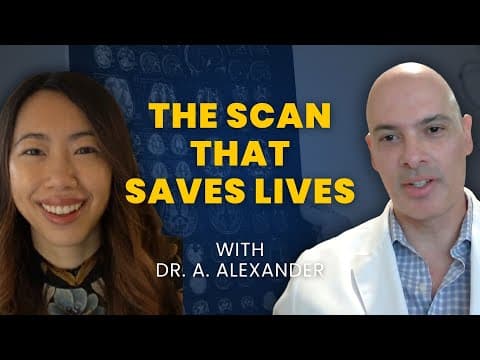
Before spending thousands of dollars on a whole-body MRI, it is worth understanding what the scan can and cannot do. In this episode, Dr. Hillary Lin talk…
The scan is sold on cancer. That is the pitch, and it is the part that does not survive contact with a radiologist who has actually read these studies. Dr. Sunil Kini — fellowship-trained in neuroradiology and body imaging, founder of Modern Teleradiology, and a former Prenuvo reader — walks Dr. Lin through the top cancers by incidence and rates whole-body MRI against each one. Breast: imaged, but not with a breast protocol. Lung: mostly air, and MRI handles air badly. Colon: no bowel prep, so you are unlikely to see anything short of enormous. Skin: in the machine the entire time, and radiologists are trained not to look at it. Prostate is the one he hands over willingly.
The organising idea is that the limits are inherent to the modality rather than to any one company's execution. Kini's read is that the scanners, the protocols and the technologists are all fine; what constrains the test is physics and a detection floor of roughly a centimetre, which is what Prenuvo itself claims. That reframes what a clean scan means. It does not mean you are cancer-free. It means that on that day, there was no macroscopic detectable tumour large enough to see — a snapshot, not a forecast.
The episode is unusually willing to sit in the discomfort of not knowing. Kini's point about overdiagnosis is that we cannot resolve it: there is no ethical way to find a lesion and deliberately watch it, so the question of which incidental findings would never have harmed anyone is close to unstudiable outside retrospective work. Both he and Dr. Lin land somewhere short of a verdict — he would rather you spent the money on a trainer, she is more sympathetic to the scan as a way to learn about your own body — and the conversation ranges into where AI in radiology actually is today, which is a long way from where the marketing says.
Before you watch
- The cancers the scan is marketed against are the ones it is worst at. Kini walks the top-incidence list and rates whole-body MRI on each: not good for breast, because the breast is in the field of view but the protocol is not tailored to it; not good for lung, because lung is full of air and reads black on MRI; terrible for colon, because the bowel is not prepped and a lesion would have to be very large and already metastatic before it declared itself. Prostate is the exception he concedes is actually pretty good.
- Skin cancer is the strangest gap. Your entire skin surface is inside the machine for the whole scan, and it contributes essentially nothing. Kini is blunt about why: radiologists are trained not to attend to the skin — it is outsourced to dermatology — so even a visible bump is not what the read is looking for.
- The detection floor is roughly a centimetre. Kini cites Prenuvo's own claim of confident detection at 1 cm and above, and notes this applies generally across solid organs, not to one body part. Anything smaller — including the early phase of a lesion — is likely to be invisible. A clean scan therefore means no sizeable macroscopic tumour on that day, which is a narrower statement than most people hear.
- Cancer is not one disease moving at one speed, and that undercuts the linear intuition. Kini's framing is that behaviour varies by type, genetics, age and size, and that a neoplastic lesion existing in your body does not by itself mean it will harm you. The honest problem is that this cannot be settled cleanly, because there is no ethical design in which you find something and choose to watch it.
- Overdiagnosis has real downstream cost, and the workup is where the harm lives. Kini's concern is the cascade: incidental findings drive further imaging, and biopsies carry organ-dependent risk. He also relays a case where a scalp biopsy was read as one lymphoma subtype, the disease recurred in bone, and re-review of the original sample showed it had been the more dangerous subtype all along — a reminder that the confirmatory test is not infallible either.
- Kini's position is that the professional bodies have already answered this. He points to statements from the American College of Radiology and from family-medicine, internal-medicine and preventive-medicine organisations that whole-body screening MRI is not indicated, and characterises the evidence base as not showing effectiveness as a screening tool. He is careful to frame these as general-population recommendations rather than a rule about any individual.
- Speed is the quality signal you can actually interrogate. Prenuvo's acquisition ran about 60 minutes; Kini has seen claims in the 20–30 minute range and is wary. His concern is AI reconstruction that acquires one sequence and extrapolates others — he reviewed one vendor whose output looked cleaner, smoother and prettier, and worried it was smoothing pathology along with noise. His practical advice: call ahead, ask what AI tool and vendor they use to shorten scan time, and research it. He did not think image quality was a problem at Prenuvo.
- AI has taken the reporting, not the reading. Kini describes report generation as effectively solved — dictate the positive findings, and a language model drops them into a normal template and produces clean prose. Image analysis is the opposite: barely dented. What exists are point solutions, one condition at a time, because training each one demands thousands of labelled cases, and no radiologist wants fifty separate tools. His guess at the path forward is training on images paired with their reports.
- Opportunistic screening is the cheaper idea hiding in plain sight. A chest CT ordered for pneumonia or pulmonary embolism has already imaged the heart, aorta, soft tissue and bone. You can go back to it and get at least a qualitative sense of coronary artery calcification — not a quantified score, but real information from a scan already paid for.
- Dr. Lin's own two experiences make the case for targeted testing over broad scanning. In her thirties, with a family history of atherosclerotic disease across her father, aunt, grandfather and grandmother, her ApoB came back the highest she had seen in her own practice; she chose carotid ultrasound over CT angiography — Kini agrees carotid disease approximates coronary disease and says it is what he would have recommended — found early atherosclerosis, and started a PCSK9 inhibitor. Her whole-body MRI, by contrast, produced interesting rather than actionable results: a lifelong vertebral displacement that finally explained a spinal protrusion, NeuroQuant brain volumetrics putting her prefrontal cortex at a striking percentile against a normative database she notes may not represent her demographically, and very little visceral fat. One test changed her management; the other did not.
- Kini would spend the money elsewhere, and says so plainly: a personal trainer or nutrition support, plus standard screening — colonoscopy, mammography — and blood biomarkers, would in his view do more for overall health than a blunt tool you might over-trust. If you do get one, he argues against annual scanning; he floats every five years while openly admitting this is an open area with no established cadence.
Chapters
Questions
Does a full-body MRI actually catch the most common cancers?
Largely not, according to Dr. Kini. Running down the top cancers by incidence, he rates whole-body MRI as poor for breast — it is in the field of view but the protocol is not breast-specific — poor for lung, because air-filled lung reads black on MRI, and worst of all for colon, since the bowel is not prepped. Skin is scanned in its entirety and effectively ignored, because radiologists are not trained to read it. Prostate is the one he says it does well. His conclusion is that the modality is weakest precisely where the marketing is strongest.
What does a clean full-body MRI result actually tell me?
That on the day of the scan, no macroscopic tumour large enough to detect was visible. Dr. Kini puts the practical detection floor at around a centimetre, citing Prenuvo's own stated threshold, so smaller lesions and early-stage disease can be present and unseen. It is a snapshot in time rather than a forecast: it does not tell you that you will not develop cancer, and it does not tell you there is nothing to worry about. Both he and Dr. Lin note that calling this preventive is a category error — imaging is diagnostic, and by the time a cancer is visible it is already there.
Are the false positives from a full-body MRI a real problem?
Dr. Kini treats overdiagnosis as the central cost rather than a footnote. Incidental findings trigger further imaging and sometimes biopsy, and biopsy risk depends heavily on the organ involved. He also points out the deeper problem: we cannot cleanly determine which findings would never have caused harm, because there is no ethical study design in which you find a lesion and deliberately do nothing. He adds that the confirmatory step can itself be wrong, describing a case where an initial lymphoma subtype was misclassified and only corrected after recurrence and re-review of the original sample.
Should I be worried if a scan center offers a very fast full-body MRI?
Dr. Kini thinks it is worth asking about. Prenuvo's acquisition ran roughly an hour, which he considers reasonable; claims well under that make him wary. His concern is AI reconstruction that acquires fewer sequences and extrapolates the rest — he reviewed one vendor whose images looked smoother and cleaner in a way he found suspicious, and worried that the same smoothing could obscure a lesion. His concrete suggestion is to call the center, ask what AI tool and vendor they use to shorten scan time, and look into it before booking. He was not concerned about image quality at Prenuvo specifically.
Is AI about to replace radiologists reading these scans?
Not on the evidence Dr. Kini describes from inside the field. He says AI has largely taken over report generation — a language model turns dictated positive findings into a formatted report, and this is in routine use — but that image analysis, the actual bulk of a radiologist's work, has barely been dented. What exists commercially are point solutions handling one finding at a time, such as lung nodules or fractures, because each requires thousands of labelled training cases. He notes that a radiologist would need dozens of separate tools to cover a single study, and that no comprehensive system has arrived yet.
If not a full-body MRI, what should I spend the money on?
Dr. Kini's answer is a personal trainer or nutrition support, the standard screening tests that do have evidence behind them, and blood biomarkers — in that order of impact over a blunt whole-body scan. He also points to opportunistic screening as underused: a chest CT you already had for another reason has imaged your heart and aorta, and can be revisited for a qualitative sense of coronary calcification at no additional scan. Dr. Lin's own workup is the illustration — a specific concern about family history and a high ApoB led to a targeted carotid ultrasound and a treatment decision, not to a whole-body scan.
The Longevity Letter
Get the weekly note
Weekly longevity science and what I would actually do with it.