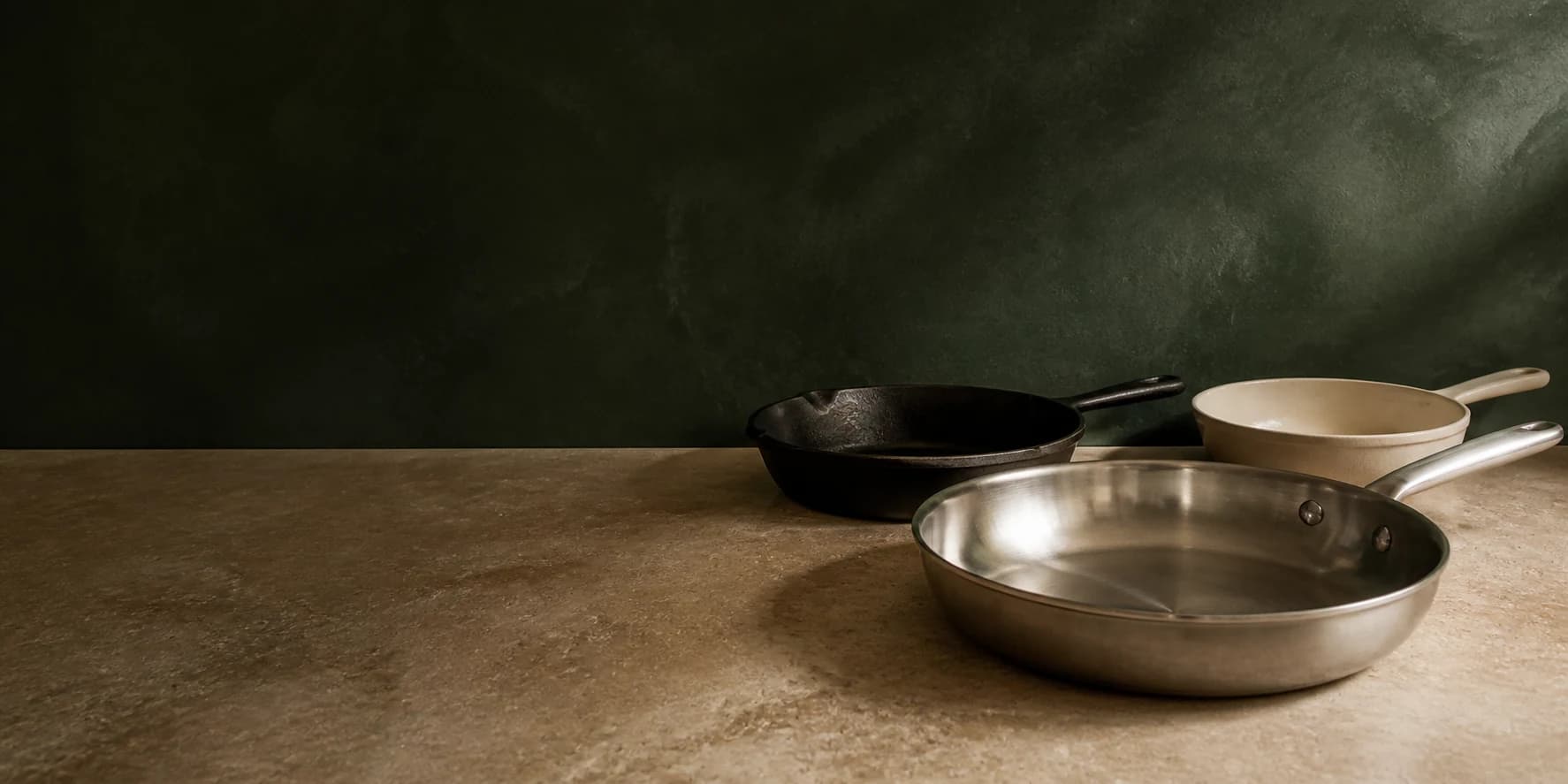
The No-BS Guide to Nonstick Cookware: PFAS, PTFE, Ceramic, Titanium, and What Is Actually Safer
If your goal is to minimize PFAS/PTFE exposure, the safest default is not a classic nonstick coating. Use stainless steel, cast iron, carbon steel, glass, or true uncoated/titanium-bonded cookware for high heat; use a PFAS-free ceramic pan only as a lower-heat convenience tool for foods like eggs and fish.
Best default
Use stainless steel, cast iron, carbon steel, glass, or true uncoated/titanium-bonded cookware for high heat.
Best compromise
Keep one PFAS-free, PTFE-free ceramic pan for lower-heat eggs, fish, pancakes, and other foods where release changes whether you cook.
Label rule
PFOA-free is not the same as PFAS-free. Buy the disclosed food-contact surface, not the slogan.

Visual summary: start with the food-contact surface, not the marketing adjective.
Cookware marketing has gotten very good at sounding scientific without actually telling you what you are cooking on.
A pan can say PFOA-free and still use PTFE. A pan can say titanium and still be a PTFE nonstick coating with titanium particles added. A pan can say ceramic and still be a short-lived coating, not solid ceramic.
If you remember nothing else, just remember: non-toxic is not a material. It is a marketing phrase.
The goal of this guide is not to make you afraid of breakfast. The goal is to help you read a cookware label in 30 seconds and know whether the food-contact surface is uncoated metal, PFAS-free ceramic, PTFE/Teflon-style nonstick, true titanium, or too vague to trust.
The short answer: what cookware is actually safer?
If your goal is to reduce PFAS/PTFE exposure, the safest default is not a classic nonstick coating.
My practical hierarchy:
- Best for high heat: stainless steel, cast iron, carbon steel, glass, and true uncoated or titanium-bonded cookware.
- Best convenience compromise: one PFAS-free, PTFE-free ceramic nonstick pan for eggs, fish, and lower-heat foods.
- Use cautiously or phase out: PTFE/Teflon-style nonstick, especially if it is scratched, peeling, overheated, old, or only marketed as PFOA-free.
- Treat as red flags: “non-toxic,” “chemical-free,” “granite,” “stone,” “hard-anodized nonstick,” or “titanium-reinforced” unless the brand clearly discloses the actual food-contact surface.
The best lower-burden kitchen is usually not a full matching “non-toxic nonstick” set. It is one durable high-heat pan, one optional PFAS-free convenience pan, and intelligent cooking habits.
Buy the science, not the slogan.
How to read a nonstick cookware label in 30 seconds
When you are looking at a pan, ask one question first:
What is the food-contact surface?
Not the color. Not the lifestyle photography. Not whether the brand says clean, green, non-toxic, mineral, stone, granite, or diamond. The surface is what matters.

Saveable label decoder: the stronger claims name the surface or coating chemistry; the weaker claims lean on adjectives.
Here is the quick decoder:
- PFOA-free: weak legacy claim. PFOA is one older PFAS manufacturing chemical. A pan can be PFOA-free and still contain PTFE/Teflon or other PFAS-related chemistry.
- PTFE-free: more useful. PTFE is the classic Teflon-style fluoropolymer coating.
- PFAS-free: useful if accurate, but ask what evidence supports it: testing, disclosure, supplier attestation, or just marketing copy.
- Ceramic nonstick: usually a silica or sol-gel coating. Often PFAS-free if the brand says PTFE-free and PFAS-free, but it is still a finite-life coating.
- Titanium-reinforced: red flag. This can mean a PTFE coating with titanium particles added. It is not the same thing as a titanium pan.
- True titanium or titanium-bonded: a different category. The food-contact surface is metal, not a sprayed PTFE or ceramic coating.
- Hard-anodized: describes the aluminum body or surface treatment, not necessarily the nonstick coating. Many hard-anodized nonstick pans still use PTFE.
- Non-toxic or chemical-free: not a real material disclosure.
Most cookware confusion comes from brands using the smallest true statement they can fit on the box.
PFAS vs PTFE vs PFOA: what these words actually mean
PFAS
PFAS are a large family of fluorinated chemicals used because they resist oil, water, stains, heat, and degradation. Those performance properties are also why PFAS raise environmental and health concerns: many are persistent, mobile, bioaccumulative, or difficult to destroy.
PFAS exposure has been associated in epidemiologic and community studies with health signals including higher cholesterol, altered immune response, liver enzyme changes, pregnancy-related hypertension, lower birth weight, thyroid disease, and kidney and testicular cancer for specific PFAS. That does not mean one skillet causes those outcomes. It means PFAS are not just a vibes-based environmental issue. They are a real public-health category.
PTFE
PTFE stands for polytetrafluoroethylene. It is the classic Teflon-style nonstick fluoropolymer.
PTFE is useful because it is chemically resistant, slick, and stable under ordinary cooking conditions. But PTFE is also in the PFAS family. That matters if your goal is to avoid fluorinated coatings, reduce lifecycle PFAS demand, or avoid the overheating pathway that can cause polymer fume fever.
PFOA
PFOA is one older PFAS that was historically used as a processing aid in the manufacture of PTFE and other fluoropolymers. Major manufacturers phased it out under EPA pressure and voluntary stewardship programs in the 2000s and 2010s.
That is why “PFOA-free” is a 2006 answer to a 2026 question.
It tells you something narrow: this one older chemical is not intentionally present. It does not tell you whether the pan is PTFE-free, PFAS-free, fluoropolymer-free, or environmentally clean.
Ceramic nonstick
Most “ceramic nonstick” cookware is not solid ceramic. It is usually an aluminum or stainless pan with a silica-based sol-gel coating.
If the brand clearly says PTFE-free and PFAS-free, ceramic nonstick can be a reasonable lower-PFAS convenience option. But it is not permanent. Ceramic coatings tend to lose their release faster than PTFE, especially with high heat, aerosol sprays, dishwasher use, aggressive scrubbing, or carbonized oil buildup.
Titanium cookware
“Titanium” can mean several different things:
- A true titanium food-contact surface.
- Titanium-bonded stainless steel.
- A pressed or engineered titanium surface designed for release.
- Titanium particles added to a PTFE coating.
- Marketing language that sounds premium but does not tell you the coating chemistry.
This is why “titanium-reinforced” is not the same thing as a titanium pan.

Titanium is the label that most needs a follow-up question: metal surface, ceramic-style surface, or reinforced PTFE? The photo examples show why the word alone is not enough.
How Teflon went from miracle convenience to PFAS cautionary tale
Nonstick cookware did not start as a wellness product. It started as industrial chemistry.
PTFE was accidentally discovered at DuPont in 1938 by Roy Plunkett, patented in 1941, and trademarked as Teflon in 1945. Early uses were industrial and strategic. The kitchen came later.
In the 1950s, Marc and Colette Grégoire adapted PTFE to cookware in France. Tefal followed, and Teflon-coated cookware entered the U.S. consumer market in the early 1960s. It was sold as convenience: less sticking, less scrubbing, easier cooking, cleaner pans.
That part was real. Anyone who has scraped eggs off a bad pan can understand why nonstick took off.
The public-health story came later. Concerns about PFOA, PFOS, contaminated drinking water, worker exposure, and community contamination brought PFAS into the regulatory spotlight. The C8 Science Panel, created after litigation involving PFOA contamination in the Mid-Ohio Valley, found probable links between PFOA exposure and several diseases, including high cholesterol, thyroid disease, ulcerative colitis, kidney cancer, testicular cancer, and pregnancy-induced hypertension.
This is not the same as saying ordinary skillet use caused those outcomes. It is saying the broader chemical system behind “easy release” had costs that were not visible to consumers when these products were normalized.
The label confusion reflects that history. “PFOA-free” became common after one legacy compound was phased out. But consumers are now asking a broader question: do I want fluorinated coatings in daily-use cookware at all?
That is a different question.

The label mess makes more sense when you see the timeline: PFOA-free solved one old issue, not the whole PFAS/PTFE question.
The health question is not just “is this pan toxic?”
“Is this pan toxic?” sounds simple. It is usually the wrong question.
There are three separate health questions.
1. PFAS/PTFE chemistry and lifecycle
For intact PTFE cookware used as directed, FDA’s public position is that polymerized nonstick cookware is expected to have negligible dietary migration under intended use. That is an important point.
But dietary migration from a finished pan is not the only concern people have. It does not answer questions about manufacturing emissions, disposal, environmental persistence, class-based substitution, overheating fumes, or consumer preference to avoid fluorinated polymers when reasonable alternatives exist.
So the nuanced answer is:
PTFE cookware used correctly is not the highest-yield PFAS exposure for most people. But if you are intentionally reducing PFAS in your home, it is reasonable to stop buying fluorinated nonstick coatings when good alternatives exist.
2. Coating failure
Scratches, peeling, chipping, and worn coatings are not a reason for instant panic. But they are a good replacement cue.
A pan that is flaking, deeply scratched, badly carbonized, or no longer releases food is no longer doing its job. At that point, the practical advice is simple: demote or replace it.
For ceramic pans, coating failure usually means frustration: more sticking, more scrubbing, more oil, and more burnt residue. For PTFE pans, coating damage also makes overheating and surface degradation more concerning.
3. Heat, smoke, and cooking behavior
A safe-looking pan does not make burnt oil safe.
Overheated PTFE can release fumes that cause polymer fume fever, also called Teflon flu. Poison Control notes that PTFE begins to break down at high temperatures, often discussed around 500°F and above, and that empty pans can get there quickly. Birds are especially sensitive.
But high heat is not only a PTFE problem. Burned oils and charred food can generate irritating fumes, aldehydes, particulate matter, heterocyclic amines, and polycyclic aromatic hydrocarbons depending on the cooking method and food.
Ventilation matters. Heat control matters. Not empty-preheating nonstick matters.
A lower-risk kitchen is a system, not a shopping cart.

The practical risk question has three parts: chemistry, coating condition, and heat behavior.
Cookware options, ranked from lowest coating concern to most claim-dependent

Use the ladder as the hierarchy: uncoated or clearly disclosed surfaces first; vague marketing last.
Lowest coating concern: uncoated and seasoned materials
This category includes stainless steel, cast iron, carbon steel, glass, and true uncoated titanium or titanium-bonded stainless.
These avoid the PFAS/PTFE coating question because there is no classic fluorinated nonstick coating. They are also usually the best choices for high heat, searing, browning, roasting, and long-term durability.
The caveat is technique. Stainless needs preheating, enough fat, and patience. Cast iron and carbon steel need seasoning and maintenance. Glass is great for baking but not a frying-pan replacement. Titanium and titanium-bonded stainless can be expensive and may not be as effortless as Teflon.
Also, uncoated does not mean risk-free in every context. Stainless steel can leach small amounts of nickel and chromium, especially with prolonged acidic cooking. Cast iron and carbon steel can increase iron in food, which may be useful for some people and not ideal for people with iron overload. Enamel and ceramic glazes should come from reputable brands with lead and cadmium testing.
Still, for daily PFAS-avoidance logic, these are the backbone.
Strong no-coating candidate: true titanium or titanium-bonded stainless
This is the interesting newer category.
Our Place’s Titanium Always Pan Pro, for example, claims a “NoCo” surface: a pressed titanium food-contact surface designed to create release without a sprayed chemical coating. The brand describes tri-ply construction with titanium interior, aluminum core, and stainless exterior, and says the pan is made without PFAS, including PTFE.
If that material disclosure is accurate, this is meaningfully different from ceramic nonstick and PTFE/Teflon. It is not a finite-life ceramic coating and not a fluoropolymer coating. It is an engineered metal surface.
The caveat: I did not find a public independent PFAS lab report for the Titanium line in this research pass. That does not make the claim false. It means I would describe it as brand-claimed unless a public lab report or disclosure is available.
Also, true no-coating titanium is not magic Teflon. It usually requires technique: preheat, use some fat, let food cook until it releases, and do not expect a cold egg to skate around like it is on ice.
Convenience compromise: PFAS-free ceramic nonstick
Ceramic nonstick is probably the most realistic compromise for people who want one easy egg pan and do not want PTFE.
Good use case:
- Eggs.
- Fish.
- Pancakes.
- Lower-heat delicate foods.
- People who will actually cook more if they have one easy pan.
What to verify:
- PTFE-free.
- PFAS-free.
- Lead and cadmium claims where relevant.
- Care instructions that match your habits.
What to accept:
- It will not last forever.
- It should be used on low to medium heat.
- It should not be treated like cast iron.
- Aerosol cooking sprays, high heat, dishwasher use, and aggressive scrubbing can shorten its life.
This category includes many brands marketed as ceramic nonstick, including GreenPan, Caraway, Blue Diamond, OXO Trident, and the original ceramic Our Place Always Pan. The health logic is better when the brand explicitly says PTFE-free and PFAS-free, and stronger when independent testing is available.
Use cautiously or phase out: PTFE/Teflon-style nonstick
PTFE is still the slipperiest category. That is why people like it.
If you already own a PTFE pan in good condition, the practical risk-reduction advice is:
- Do not preheat it empty.
- Do not use high heat or broil it.
- Use ventilation.
- Avoid metal utensils and abrasive scrubbers.
- Replace it if it is peeling, flaking, deeply scratched, or badly overheated.
- Keep birds out of the kitchen during any nonstick cooking risk.
But if you are buying new cookware and your stated goal is PFAS avoidance, I would not buy more classic PTFE nonstick. The existence of low-burden alternatives changes the default.
Most misleading label zone: titanium, stone, granite, hybrid, hard-anodized
This is where people get trapped.
“Titanium,” “stone,” “granite,” and “hard-anodized” can describe color, texture, body construction, reinforcement particles, or marketing aesthetics. They do not automatically tell you whether the nonstick surface is PTFE, ceramic, or uncoated metal.
The question to ask is always:
Is the actual food-contact nonstick surface PTFE, ceramic, or no coating?
If the brand will not answer that, I would not treat the pan as a trustworthy PFAS-avoidance choice.
Brand examples: how to decode the claims
These are not product rankings. They are label-literacy case studies.
Our Place Titanium Always Pan Pro
This is one of the more interesting claims because it is positioned as constructed nonstick rather than coated nonstick.
Health read: promising if the material disclosure is accurate. A titanium food-contact surface with no PFAS/PTFE coating avoids the classic fluorinated coating issue. But do not call it independently verified unless the brand provides public lab testing. Also, expect a stainless-like learning curve rather than Teflon-level slipperiness.
OXO Trident
OXO Trident appears to be a stainless hybrid pan with a diamond-infused ceramic nonstick surface and PFAS-free positioning.
Health read: a PFAS-free ceramic convenience category, not the same as a true no-coating titanium pan. It may be a reasonable lower-PFAS nonstick option if the claims are accurate, but it is still a coating.
Caraway, GreenPan, and Blue Diamond
These brands sit in the ceramic/sol-gel nonstick category. GreenPan describes Thermolon as a sand-derived ceramic coating made without PFAS, including PTFE and PFOA. Caraway markets third-party-tested ceramic cookware made without PTFE, PFOA, PFAS, lead, and cadmium. Blue Diamond uses similar ceramic/PFAS-free positioning.
Health read: reasonable convenience options if you accept finite lifespan and care rules. Do not translate “non-toxic” into “permanent” or “risk-free.”
Hestan NanoBond
Hestan NanoBond is a titanium-bonded stainless category. It is durable, premium, and coating-free in the classic nonstick sense, but it is not the same as traditional nonstick.
Health read: strong logic for people who want high-heat durability and no PFAS/PTFE coating. It still requires cooking technique.
T-fal titanium and hard-anodized nonstick
T-fal is useful as a label lesson because its disclosures make clear that PTFE-coated products can contain PFAS chemicals including PTFE, PFA, and FEP. Some product names include “titanium,” but that does not mean the food-contact surface is true titanium.
Health read: do not assume titanium-branded equals PFAS-free.
Scanpan Stratanium
Scanpan’s own FAQ says its nonstick coatings contain PTFE, while its ceramic coatings do not contain PTFE or other PFAS.
Health read: this is exactly the distinction consumers need. PFOA-free is not the same as PTFE-free. Name the exact line.
HexClad
HexClad is a product-vintage cautionary tale. Older hybrid nonstick claims were scrutinized because products contained PTFE despite “non-toxic” style positioning. Newer TerraBond claims describe a ceramic formula free from PTFE/PFAS, lead, and cadmium.
Health read: do not say “HexClad is safe” generically. Ask which line, which year, and which coating.
Xtrema and solid ceramic or glazed cookware
True ceramic or glazed cookware is a different category. The concern is not PFAS/PTFE so much as quality control, lead/cadmium leach testing, fragility, and performance.
Health read: good brands should provide testing. Be more cautious with vintage, imported, handmade, or unknown ceramic/glazed cookware used for food contact.
The low-drama cookware setup I would recommend
For most people, I would not recommend replacing every pan at once.
Start with the daily-use frying pan.
A practical lower-burden setup:
- One high-heat workhorse. Stainless steel, carbon steel, cast iron, true titanium, or titanium-bonded stainless. Use this for searing, browning, sautéing, and anything involving higher heat.
- One optional convenience pan. A PFAS-free, PTFE-free ceramic pan for eggs, fish, pancakes, or the food that keeps you from cooking if it sticks.
- One nonreactive pot or vessel. Stainless, glass, or enameled cast iron for acidic sauces, soups, braises, and slow cooking.
- A ventilation habit. Use the hood, open a window when needed, avoid smoking oil, and do not empty-preheat nonstick.
Replace the daily frying pan first. That is usually higher-yield than buying an entire matching “non-toxic” set.

The practical endpoint is a small, durable setup, not a fear-driven full replacement spree.
When to replace a nonstick pan
Replace or demote a nonstick pan when:
- The coating is peeling, flaking, or deeply scratched.
- A PTFE pan was overheated badly or smoked.
- A ceramic pan has lost release and now requires aggressive scrubbing.
- The pan has carbonized residue you cannot remove without abrasion.
- The enamel or glaze is chipped on the cooking surface.
- An aluminum core is exposed.
- The pan makes you cook worse because everything sticks, smokes, or burns.
Use rules that matter:
- Do not empty-preheat classic nonstick.
- Use low to medium heat for PTFE and ceramic.
- Ventilate high-heat cooking no matter what pan you use.
- Do not treat 850°F or 1000°F marketing as a cooking recommendation.
- Use the pan that matches the job: stainless or cast iron for searing, ceramic for delicate lower-heat release.

Replacement should be boring and practical: the photo callouts show the kind of visible wear this checklist means.
How I evaluated cookware safety claims
For this guide, I treated brand pages as claims, not proof.
I weighted:
- Regulatory and public-health sources: FDA, EPA, ATSDR/CDC, Poison Control.
- Historical and regulatory context: EPA’s PFOA Stewardship Program, C8 Science Panel, California AB1200, Minnesota Amara’s Law, and broader PFAS policy direction.
- Independent consumer/product testing context: Consumer Reports and Ecology Center Healthy Stuff Lab.
- Brand disclosures and product pages: useful for identifying what companies claim, but not the same as independent verification.
Product pages tell us what brands say. Regulatory and independent sources help us decide how much weight those claims deserve.
This guide is exposure-reduction education, not medical advice. A cookware change should not be sold as a disease-prevention intervention. It is one practical home-exposure decision among many.
Clinical lens
How I’d decide
Use this section as a second pass after the main answer, not as homework before you know what the page is saying.
Who it’s for
People trying to reduce PFAS/PTFE exposure at home without turning cookware into a fear project, especially anyone buying or replacing a daily-use frying pan.
Who should skip it
People looking for a disease-treatment claim, a perfect zero-risk material, or a generic affiliate-style best-pan ranking. This is exposure-reduction and claim-literacy guidance, not personal medical advice.
Measure before / after
No routine biomarker is required before replacing a pan. If PFAS exposure is a serious concern, prioritize higher-yield sources like drinking water, occupational exposure, dust, food packaging, and clinician-guided PFAS testing only when it would change action.
What I’d do first
Replace the daily frying pan first if it is worn or fluoropolymer-based and you are trying to reduce PFAS. Keep one durable high-heat workhorse, one optional PFAS-free ceramic convenience pan, one nonreactive vessel, and a ventilation habit.
What would change my mind
Line-specific independent testing, clearer AB1200/PFAS disclosures, or a brand revealing that a “titanium,” “stone,” “granite,” or “hybrid” surface is actually PTFE/fluoropolymer-based.
Frequently Asked Questions
What is the safest nonstick cookware?
If your goal is to minimize PFAS/PTFE exposure, the safest default is not a classic nonstick coating. Use stainless steel, cast iron, carbon steel, glass, or true uncoated/titanium-bonded cookware for high heat. If you need a slippery egg pan, choose ceramic nonstick that is explicitly PTFE-free and PFAS-free, use low to medium heat, and replace it when the coating wears.
Is PTFE the same as PFAS?
PTFE is a fluoropolymer in the PFAS family. Teflon is the best-known brand name for PTFE. This matters because a pan can be PFOA-free and still contain PTFE.
Is Teflon cookware dangerous?
Teflon-style PTFE cookware is generally considered stable when used correctly at ordinary cooking temperatures. The acute risk is overheating, especially empty-preheating or high heat, which can release fumes associated with polymer fume fever. If you keep PTFE pans, use low to medium heat, ventilate, and replace damaged pans.
Is PFOA-free cookware safe?
PFOA-free is not the same as PFAS-free. It means one older PFAS manufacturing chemical is absent, but the pan may still contain PTFE or other PFAS-related chemistry. For PFAS avoidance, look for PTFE-free and PFAS-free, or choose uncoated materials.
Is ceramic nonstick cookware safer than Teflon?
Ceramic nonstick is usually a silica/sol-gel coating rather than a fluoropolymer. If it is truly PTFE-free and PFAS-free, it avoids the classic fluorinated-coating issue. The tradeoff is durability: ceramic nonstick wears faster and should be treated as a replaceable convenience pan.
Is titanium cookware non-toxic?
“Titanium” can mean very different things. A true titanium or titanium-bonded food-contact surface is different from “titanium-reinforced” PTFE. The first may avoid polymer coating concerns; the second can still be Teflon-style nonstick with titanium particles added.
What is the safest pan for eggs?
For eggs, the most practical lower-PFAS option is often a dedicated PFAS-free, PTFE-free ceramic pan used on low to medium heat. If you are willing to learn technique, seasoned carbon steel or cast iron can also work well. For maximum ease, ceramic is the compromise; for maximum durability, learn an uncoated or seasoned pan.
What cookware is best for high heat?
For high heat, use stainless steel, cast iron, carbon steel, true titanium, titanium-bonded stainless, or other uncoated high-heat materials. Avoid using PTFE or ceramic nonstick for searing or broiling. High heat can also create fumes from oils and food, so ventilation matters even with uncoated cookware.
Should I throw away scratched nonstick pans?
You do not need to panic, but scratched, peeling, flaking, or badly worn nonstick pans should be replaced or demoted. The pan is no longer performing well, and damaged coatings are harder to use safely. If the pan is PTFE, be especially careful about overheating and ventilation until you replace it.
Does AB1200-compliant mean PFAS-free?
No. California AB1200 is a disclosure and labeling law for certain chemicals in cookware, not a clinical safety certification. It helps police vague “free of” claims, but it does not automatically mean a product is independently tested or the best choice for PFAS avoidance.
Are stainless steel, cast iron, and carbon steel completely risk-free?
No cookware material is perfect. Stainless can leach small amounts of nickel and chromium during prolonged acidic cooking, cast iron and carbon steel can increase iron in food, and enamel or ceramic glazes require quality control for lead and cadmium. They are still strong defaults for PFAS/PTFE avoidance because they do not rely on fluorinated nonstick coatings.
References & citations
- 1.ATSDR. PFAS and health effects
- 2.FDA. Authorized uses of PFAS in food-contact applications
- 3.Poison Control. Protect yourself from Teflon flu
- 4.EPA. Fact Sheet: 2010/2015 PFOA Stewardship Program
- 5.C8 Science Panel. Probable Link Reports
- 6.Blum A, et al. The Madrid Statement on Poly- and Perfluoroalkyl Substances. Environmental Health Perspectives. 2015
- 7.Consumer Reports. You Can't Always Trust Claims on 'Non-Toxic' Cookware
- 8.Ecology Center Healthy Stuff Lab. Undisclosed PFAS Coatings Common on Cookware
- 9.California AB1200 bill text
- 10.Minnesota Pollution Control Agency. PFAS in products
- 11.Our Place. Titanium Always Pan Pro
- 12.GreenPan. FAQs
- 13.Caraway. Ceramic Cookware Set
- 14.T-fal. About Our Nonstick
- 15.Scanpan. Does Scanpan cookware contain PTFE?
- 16.National Cancer Institute. Chemicals in meat cooked at high temperatures
- 17.Stainless steel leaching study
Next step
Turn the guide into the right next decision.
If this page raised a real clinical question, start with the practice details. If you are still learning, get the weekly letter. If you are comparing tests, use the testing hub before buying another panel.