Full-Body MRI Screening: What It Can Find, What It Can Miss
Whole-body MRI can sometimes find important findings earlier, but it is not a substitute for evidence-based cancer screening and it is not a universal rec…
Dr. A. Alexander is not the person you expect to be defending whole-body MRI. He was at the National Institute on Aging in 1999 working on caloric restriction and primate longevity, then spent years as team physician to the Lakers and the Dodgers, and when he first asked a colleague about whole-body imaging he was told flatly that nobody was doing it in a way worth sending your family to. That colleague — Dr. Brian Tsui, then at UCSF, who had spent years cleaning up the misses and overcalls arriving in follow-up — is now his co-founder at CoreViva. The episode is the operator's case, made by someone who started as the skeptic.
The organising claim is that the criticism is aimed at the wrong target. Alexander does not argue whole-body MRI replaces the screening tests that work — he is explicit that Pap smears, mammography from 40 and colonoscopy from 45 remain the standard, that mammography catches 1–2 mm microcalcifications MRI cannot, and that he would never tell a patient to skip it. His argument is about the gap on the other side: outside those three tests and low-dose CT for smokers, there is no established screening pathway for ovarian, pancreatic or renal cancer, for brain aneurysm, or for early fatty liver. Dr. Lin's own framing in the conversation is that these scans are mismarketed as cancer screening, and Alexander largely agrees — his tagline is 'know your body', not 'catch your cancer'.
Where the episode demands the most from a listener is the performance claims. Alexander reports 10 confirmed early-stage cancers plus one advanced in roughly two months of operation, says the scan sees lung lesions the conventional teaching says MRI should miss, and states his false-positive rate is currently zero. These are the founder's own numbers from a very young service, and he volunteers that the zero will not hold. Worth reading alongside the companion episode with Dr. Sunil Kini, whose account of the same modality's limits is considerably less optimistic — the two conversations disagree substantively, and the disagreement is the useful part.
Before you watch
- Alexander does not position the scan as a replacement for real screening, and is unusually specific about why. Mammography stays because it resolves 1–2 mm microcalcifications that can turn out to be DCIS, which MRI cannot reach — even a contrast-enhanced breast-specific MRI shows a region of enhancement rather than pinpointing the calcifications. Pap smears and colonoscopy stay for the same reason: they are the tests with the evidence. His pitch is additive, not substitutive.
- The gap he is aiming at is the set of cancers with no screening pathway at all. Outside cervical, breast, colon and low-dose CT lung screening for smokers, he lists ovarian, pancreatic, renal cell and liver cancer, plus brain aneurysm and early fatty liver disease, as conditions with no established asymptomatic screening route. That is a genuine hole, and it is a stronger argument than the cancer-catchall framing the category usually sells on.
- The claimed results are the founder's own, from a short window. In roughly two months of operation he reports 10 confirmed early-stage cancers and one advanced — including ovarian, liver and a lung cancer he puts at about 5 mm — along with two brain aneurysms and multiple fatty liver findings. He cites 10 at one point and 11 at another. These are uncontrolled operational numbers with no denominator given, not a published detection rate.
- The zero false-positive claim deserves the scrutiny Alexander himself gives it. He states that everything CoreViva has called has been correct and that the current false-positive rate is zero, attributing it to a double read by two radiologists plus AI. He then immediately adds that he is sure something will eventually slip through. A zero rate over two months in a new service is a statement about a small denominator, not an established property of the test — and false-positive rate is the single metric on which the whole category has been criticised.
- The lung finding directly contradicts the conventional teaching, and the episode says so. Dr. Lin raises the standard position — you use CT for lung because MRI handles air-filled tissue badly — and Alexander's response is that they can see it as long as the lesion is large enough, citing the roughly 5 mm cancer they caught and 2–3 mm nodules they have visualised. This is the sharpest factual disagreement with the companion Kini episode, where lung is listed among the modality's clear weaknesses.
- Slice thickness is the mechanism he credits, and he has a case to attach to it. A patient scanned early on was found to have an early brain tumour. When symptoms appeared, an academic medical centre declined to look at CoreViva's images, ran its own thicker-slice study, missed the lesion and hedged it as possible inflammation; a second centre also dismissed it. A neurosurgeon who finally reviewed the CoreViva images agreed with the original call. Alexander's read is that thin slices are the differentiator; the story is also, unavoidably, a founder's account of his own product.
- Everyone has something, and it is almost always the neck. Across every patient scanned so far — youngest 20, oldest 92 — Alexander says all of them had a musculoskeletal finding, most commonly in the cervical spine: disc bulge, disc dehydration, facet arthropathy. He attributes it to phone posture and frames the response as prehab rather than rehab. It is also the clearest illustration of the overdiagnosis problem, since a 100% finding rate is not a screening result so much as a description of being a body.
- The workflow is the part that is genuinely different from the category norm. A comprehensive digital intake form goes in before the scan, on the argument that radiologists normally read against a one-word indication like 'pain'; the acquisition runs about 30 minutes; the patient meets the reading radiologist immediately afterwards rather than waiting on a portal; and the full report follows within 48 hours with a composite AI-derived score covering brain age, musculoskeletal age, visceral fat and muscle bulk against chronological age.
- On cadence he argues annual, and Dr. Lin presses him on it. His rationale is that aggressive cancers — pancreatic, ovarian, brain — do not wait, and that a scan is nothing like a colonoscopy's ten-year clean window. Dr. Lin's pushback is that some tumours go from nothing to dangerous inside twelve months anyway; he concedes that the fastest-growing ones will declare themselves symptomatically, and that risk-adjusted frequency is what he expects once there is enough data to support it. The scan is $2,699 and not covered; he argues early-stage treatment runs at least five times cheaper than late-stage and expects roughly a decade before CMS moves.
- His most useful correction has nothing to do with imaging: most people do intermittent fasting wrong. Alexander's point from the NIA work is that the mechanism is calorie reduction — the window is a device for removing a meal, not for compressing the same intake into four hours. He describes patients who cannot lose abdominal fat while eating an unchanged 2,000 calories inside a shortened window. He now runs a relaxed ~12-hour fast and cycles intake instead, eating heavily on hard training days and sometimes skipping a meal on rest days, drawing on nematode work from his old group suggesting cycling activated similar pathways to sustained restriction.
- He thinks the 200-biomarker panel is the most overhyped thing in longevity right now, and the objection is about action rather than cost. His line — since when was sodium a biomarker — points at the reclassification of ordinary chemistry as insight, and his concern is that most of those values will not change anything you do, while a mildly out-of-range result that is simply your normal invites overcorrection and real harm. He puts the useful annual set at roughly 15 tests. Dr. Lin adds the reference-range problem: those ranges are population-derived, and normal for one person is not normal for another.
Chapters
Questions
Does a full-body MRI replace mammograms and colonoscopies?
No, and Alexander is emphatic about it. He describes Pap smears for cervical cancer, mammography from age 40 and colonoscopy from age 45 as the gold standard, and says CoreViva tells patients to continue all of them. His specific reason on breast is resolution: mammography picks up 1–2 mm microcalcifications that can represent DCIS, and MRI is not at that level — even a contrast-enhanced breast-specific MRI will show enhancement in a region rather than pinpointing the calcifications. The argument for a whole-body scan is that it covers organs with no screening pathway at all, not that it replaces the tests that already work.
What can a full-body MRI find that standard screening misses?
Alexander's list is the conditions with no established asymptomatic screening route: ovarian, pancreatic, renal cell and liver cancer, brain aneurysm, and early fatty liver disease. Standard screening covers cervical, breast and colon cancer, plus low-dose CT for lung in smokers — outside that, there is essentially nothing offered to a healthy person. He reports 10 confirmed early-stage cancers plus one advanced case in roughly two months of operation, along with two brain aneurysms. Those are his own operational figures from a new service rather than published detection rates, and should be read that way.
Can a full-body MRI really have a zero false-positive rate?
That is Alexander's stated figure, and it is worth holding carefully. He attributes it to three sets of eyes on every study — himself, co-founder Dr. Brian Tsui, and their AI — and says everything they have called has proved correct. He also says, unprompted, that he is sure something will eventually slip through. The honest reading is that this is a claim from a founder about a service open roughly two months, so the denominator is small and the rate is not yet a stable property of anything. False positives are the central criticism of the whole category, so it is also the claim most in need of independent confirmation.
How often should you get a full-body MRI?
Alexander argues annually and does it himself, on the reasoning that aggressive cancers such as pancreatic, ovarian and brain tumours progress far faster than the ten-year window a clean colonoscopy buys you. Dr. Lin presses the obvious objection — some tumours go from undetectable to dangerous inside a year regardless — and he concedes that the fastest-growing cancers will announce themselves through symptoms before any plausible scanning interval catches them. He expects risk-adjusted intervals rather than a universal annual rule once there is enough data to stratify people. It is worth noting the companion episode with Dr. Sunil Kini reaches close to the opposite conclusion, floating every five years at most.
Am I doing intermittent fasting wrong if I'm not losing weight?
Possibly, and Alexander thinks this is the most common error in the practice. His position, drawn from caloric restriction work at the National Institute on Aging, is that the eating window is a mechanism for removing a meal rather than an end in itself — the benefit runs through reduced intake. He describes patients frustrated at unchanged abdominal fat who, on questioning, are eating the same 2,000 calories compressed into four hours. He has since moved to a looser roughly 12-hour fast combined with cycling intake up on hard training days and down on rest days, based on earlier nematode work from his group suggesting cycling activated similar pathways.
Are large biomarker panels with 100+ tests worth it?
Alexander names them as the most overhyped thing in longevity right now, and his objection is about actionability rather than price. His argument is that routine chemistry has been rebranded as insight — his example is sodium — and that most of those values will not change any decision you make. The sharper concern is harm: a result slightly outside a population range may simply be your normal, and correcting it can produce genuine problems. He puts the useful annual panel at roughly 15 tests. Dr. Lin's addition is that reference ranges are derived from population distributions in the first place, so fitting inside them is not the same as being well.
Get The Longevity Letter
Weekly longevity science and what I would actually do with it.
Related Episodes
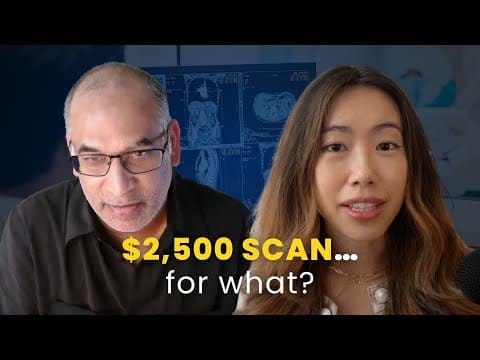
Full-Body MRI: What It Misses, False Positives & Smarter Screening
Jun 30, 2025
Why Primary Care Could Be the Real Longevity Breakthrough
Aug 23, 2025

Peptides: What I’m Not Seeing in My Patients | Dr. Mayoni
Sep 22, 2026
Your Inflammation Test Is High. Are You Actually Inflamed?
Sep 17, 2026