OmegaCheck and theOmega-6:Omega-3 Ratio
Start with the assay and the individual fatty acids. I want to know whether marine omega-3 is low, whether food or a supplement changed the result, and whether the test adds anything to the decision. I would not treat 4:1 as a universal target or cut nuts, seeds, and ordinary plant oils to lower the ratio.

What the test measures
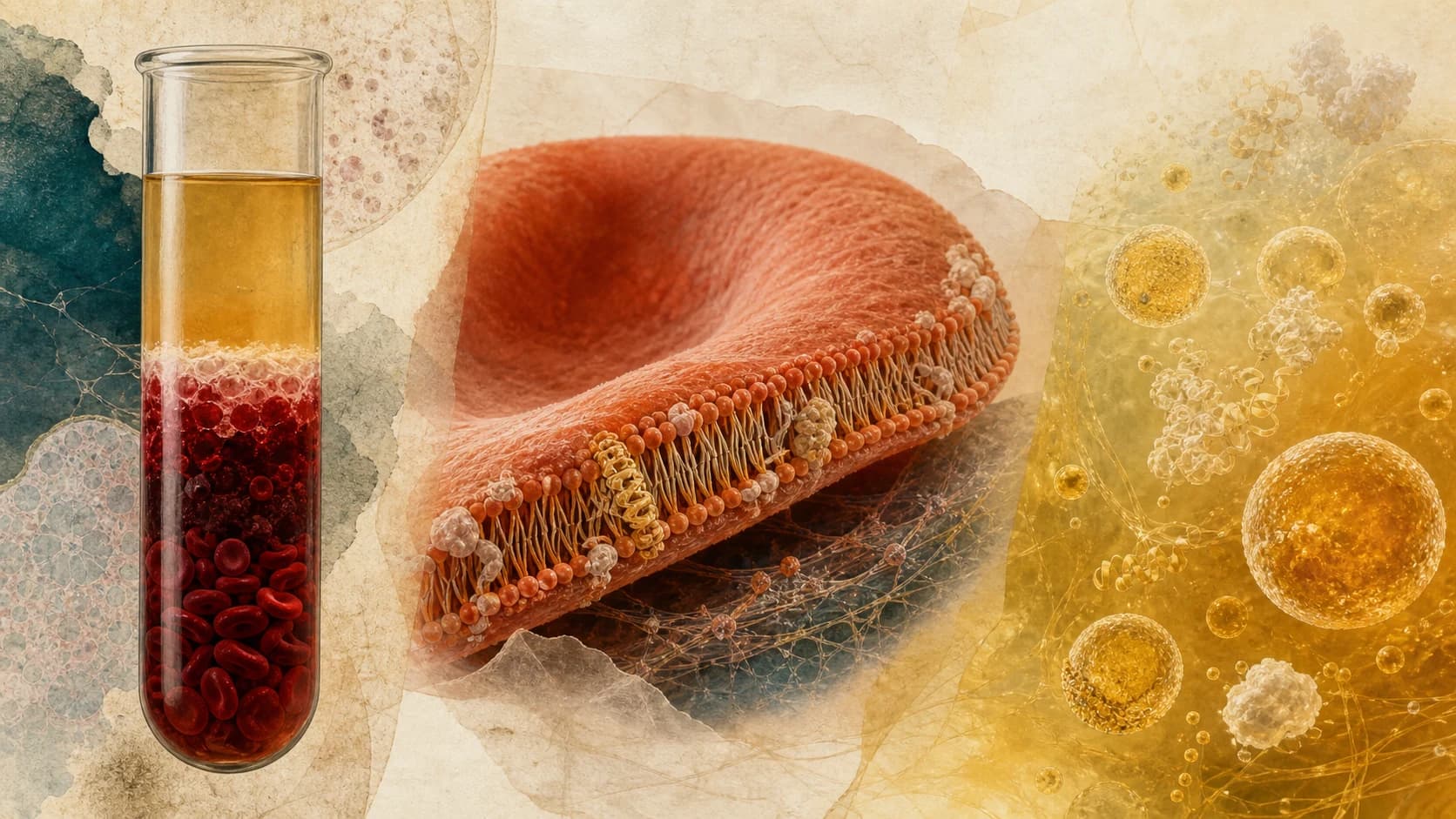
Quest's OmegaCheck reports whole-blood EPA + DPA + DHA as a percentage of the measured whole-blood fatty acids. I read it as an exposure marker: a clue about food, supplements, absorption, and adherence. I would not use it to diagnose inflammation or make a treatment decision on its own.
5.5% or higher: Quest calls this its lower relative cardiovascular risk category.
3.8% to 5.4%: Quest calls this its moderate relative cardiovascular risk category.
3.7% or lower: Quest calls this its higher relative cardiovascular risk category. These are observational relative-risk categories, not deficiency labels or treatment thresholds.
First, make sure you are comparing the same test
OmegaCheck measures whole-blood EPA + DPA + DHA. The Omega-3 Index measures red-cell EPA + DHA. Plasma is a third compartment, and it moves more with recent intake. The tests may correlate, but their percentages and cutoffs do not transfer between assays.
Assay comparison
OmegaCheck
- What is measured
- Whole blood: EPA + DPA + DHA
- What I keep in mind
- Quest's 5.5% category is observational. It is not a validated treatment target.
Omega-3 Index
- What is measured
- Red-cell membranes: EPA + DHA
- What I keep in mind
- Its proposed 8% target does not transfer to OmegaCheck.
Plasma fatty acids
- What is measured
- Plasma fatty acids; calculation depends on the panel
- What I keep in mind
- Recent intake and metabolic state can move the result. There is no universal plasma cutoff.
| Test | What is measured | What I keep in mind |
|---|---|---|
| OmegaCheck | Whole blood: EPA + DPA + DHA | Quest's 5.5% category is observational. It is not a validated treatment target. |
| Omega-3 Index | Red-cell membranes: EPA + DHA | Its proposed 8% target does not transfer to OmegaCheck. |
| Plasma fatty acids | Plasma fatty acids; calculation depends on the panel | Recent intake and metabolic state can move the result. There is no universal plasma cutoff. |
Know the assay
A lower ratio is not automatically better
The omega-6:omega-3 ratio divides one group of fatty acids by another. Before acting on it, I inspect the values that produced it. A lower ratio can mean omega-3 rose, omega-6 fell, or both changed. Those are different biological changes.
The often-cited Lyon Diet Heart Study tested a Mediterranean-style diet after myocardial infarction. It did not isolate a 4:1 ratio, and no validated universal 4:1 target exists.
Ratio math
How the ratio can fall
The ratio is omega-6 divided by omega-3.
Omega-3 rises
Omega-6 stays steady while omega-3 rises
The ratio falls. This often reflects more marine omega-3 exposure.
Omega-6 falls
Omega-3 stays steady while omega-6 falls
The ratio also falls. The arithmetic is the same, but the biological change is different.
Assay matters: a dietary ratio is not the same measurement as a plasma, whole-blood, red-cell, or arachidonic-acid-to-EPA ratio.
Treatment evidence: no trial has assigned people to ratio-guided care and shown better outcomes.
Food decisions: I would not lower ordinary omega-6 foods just to improve the arithmetic.
What the human data can support
Pooled cohort data link higher EPA, DPA, and DHA with lower mortality, but they cannot tell us that supplementing to a commercial cutoff will reproduce that association.
Ordinary linoleic-acid intake is not proven to cause systemic inflammation. Trials generally do not show inflammatory markers rising with intake, and higher linoleic-acid biomarkers have not been linked to higher cardiovascular risk.
For risk prediction: some plasma ratio studies predict risk, but that does not make the ratio a treatment target.
For treatment: No outcomes trial validates treating to an OmegaCheck or ratio cutoff.
For food choices: I would not remove nuts, seeds, or ordinary unsaturated plant oils based on this test alone.
Food, fish oil, and prescription EPA are not the same treatment
VITAL tested 1 gram per day of marine omega-3 in generally healthy adults and did not significantly reduce its primary cardiovascular endpoint. STRENGTH tested 4 grams per day of mixed EPA+DHA in high-risk patients and was neutral. REDUCE-IT tested 4 grams per day of purified prescription EPA in selected statin-treated patients and reduced events.
VITAL, STRENGTH, and REDUCE-IT studied different products and populations. REDUCE-IT does not validate over-the-counter fish oil.
What the studies found
Low-mercury fish and seafood
- What the evidence supports
- A sound food choice. Any benefit can include what the fish replaces, along with its protein, minerals, and food matrix.
Ordinary mixed EPA+DHA supplement
- What the evidence supports
- It can raise blood omega-3. Broad primary-prevention trials have not consistently reduced cardiovascular events.
High-dose mixed EPA+DHA
- What the evidence supports
- It lowers triglycerides, but STRENGTH did not show fewer major cardiovascular events.
Prescription icosapent ethyl
- What the evidence supports
- Purified EPA reduced events in REDUCE-IT for selected statin-treated high-risk patients with elevated triglycerides. That result is specific to the product and population studied.
| Intervention | What the evidence supports |
|---|---|
| Low-mercury fish and seafood | A sound food choice. Any benefit can include what the fish replaces, along with its protein, minerals, and food matrix. |
| Ordinary mixed EPA+DHA supplement | It can raise blood omega-3. Broad primary-prevention trials have not consistently reduced cardiovascular events. |
| High-dose mixed EPA+DHA | It lowers triglycerides, but STRENGTH did not show fewer major cardiovascular events. |
| Prescription icosapent ethyl | Purified EPA reduced events in REDUCE-IT for selected statin-treated high-risk patients with elevated triglycerides. That result is specific to the product and population studied. |
Separate the products

How I would use the result
I start with why the test was ordered and then look at the individual fatty acids. If cardiovascular risk is the question, established cardiovascular risk factors remain first: ApoB or non-HDL cholesterol, blood pressure, glycemia, smoking, kidney disease, Lp(a), family history, plaque, and prior cardiovascular disease. OmegaCheck should not outrank them.
What I check next
EPA + DPA + DHA is low
- My first read
- Marine omega-3 exposure may be low.
- What I check
- Confirm the assay, fish intake, labeled EPA+DHA dose, adherence, dietary pattern, and possible malabsorption.
The ratio is high but omega-6 is not
- My first read
- The omega-3 denominator may be low.
- What I check
- Inspect the individual fatty acids. I would not cut nuts, seeds, or ordinary unsaturated plant oils to improve the ratio.
OmegaCheck is already high
- My first read
- More is not automatically better.
- What I check
- Review the dose and why it is being used, especially with high-dose long-term supplementation.
The question is cardiovascular risk
- My first read
- Established risk factors carry more weight.
- What I check
- Address those risks first. Make any prescription EPA decision separately.
| Finding | My first read | What I check |
|---|---|---|
| EPA + DPA + DHA is low | Marine omega-3 exposure may be low. | Confirm the assay, fish intake, labeled EPA+DHA dose, adherence, dietary pattern, and possible malabsorption. |
| The ratio is high but omega-6 is not | The omega-3 denominator may be low. | Inspect the individual fatty acids. I would not cut nuts, seeds, or ordinary unsaturated plant oils to improve the ratio. |
| OmegaCheck is already high | More is not automatically better. | Review the dose and why it is being used, especially with high-dose long-term supplementation. |
| The question is cardiovascular risk | Established risk factors carry more weight. | Address those risks first. Make any prescription EPA decision separately. |
Check the dose before adding more
High-dose long-term marine omega-3 has an atrial-fibrillation safety signal in cardiovascular outcomes trials, especially above 1 gram per day. I review the dose and its purpose, with extra care around prior atrial fibrillation, procedures, and antiplatelet or anticoagulant therapy.
Know the product: record the daily EPA and DHA amount, not just total fish-oil milligrams.
Know the job: correcting low exposure is a different decision from prescription treatment for a selected high-risk patient.
Stop and review: do not keep escalating the dose because the ratio has not reached a preferred number.
Frequently Asked Questions
Should I aim for a 4:1 ratio?
No. There is no validated universal 4:1 target, and a dietary ratio is not the same measurement as a blood ratio.
Should I cut omega-6 foods if my ratio is high?
Not based on the ratio alone. Ordinary linoleic-acid intake is not proven to cause systemic inflammation, and nuts, seeds, and unsaturated plant oils can fit a healthy diet.
Can I compare OmegaCheck with the Omega-3 Index?
Not directly. OmegaCheck is whole-blood EPA + DPA + DHA. The Omega-3 Index is red-cell EPA + DHA. Their percentages and cutoffs are not interchangeable.
Does REDUCE-IT validate over-the-counter fish oil?
No. REDUCE-IT studied prescription purified EPA in selected statin-treated high-risk patients. It does not validate ordinary mixed EPA+DHA supplements.
Can high-dose omega-3 raise atrial fibrillation risk?
High-dose long-term marine omega-3 has increased atrial fibrillation in cardiovascular outcomes trials. The dose deserves review, especially with prior atrial fibrillation or when long-term high-dose use is being considered.
References & citations
- 1.Quest Diagnostics: OmegaCheck, test code 92701
- 2.NIH Office of Dietary Supplements: Omega-3 Fatty Acids Fact Sheet for Health Professionals
- 3.Harris and von Schacky, Preventive Medicine 2004: The Omega-3 Index
- 4.Zhang et al., eLife 2024: Omega-6 to omega-3 ratio and mortality
- 5.Harris, Prostaglandins, Leukotrienes and Essential Fatty Acids 2018: Critical appraisal of the ratio
- 6.Johnson and Fritsche, Journal of the Academy of Nutrition and Dietetics 2012: Linoleic acid and inflammation review
- 7.Marklund et al., Circulation 2019: Omega-6 biomarkers and cardiovascular outcomes
- 8.Li et al., American Journal of Clinical Nutrition 2020: Linoleic acid and mortality meta-analysis
- 9.American Heart Association 2009: Omega-6 fatty acids and cardiovascular disease
- 10.Manson et al., New England Journal of Medicine 2019: VITAL marine omega-3 trial
- 11.Nicholls et al., JAMA 2020: STRENGTH trial
- 12.Bhatt et al., New England Journal of Medicine 2019: REDUCE-IT
- 13.Gencer et al., Circulation 2021: Marine omega-3 supplementation and atrial fibrillation
- 14.Abdelhamid et al., Cochrane Database of Systematic Reviews 2020: Omega-3 for cardiovascular prevention
- 15.Goyens et al., American Journal of Clinical Nutrition 2006: ALA conversion and dietary amounts
Related Guides
Before changing the dose
Bring the report and the supplement label.
The assay name, individual fatty acids, and exact EPA/DHA dose matter more than the ratio alone. If cardiovascular risk is the question, review those risk factors separately.